You bet the flop. You barrel the turn. Then the river completes one of the most obvious draws on the board.
A passive opponent suddenly raises. Or a player who has shown almost no aggression all session comes over the top after you value bet.
Part of you already knows what the hand is telling you.
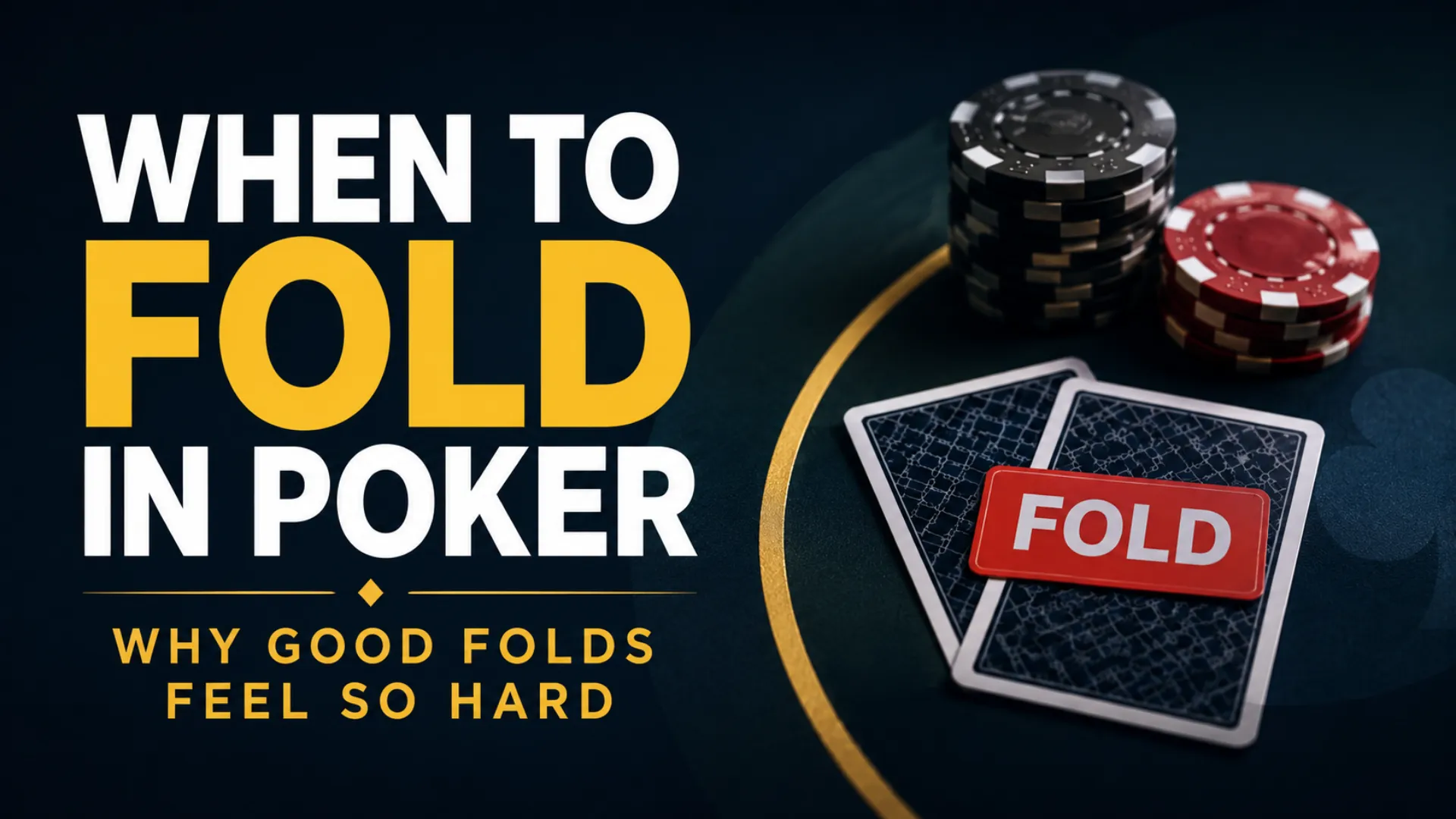
Fold.
Yet the longer you look at the pot, the harder that button becomes to press.
This happens even to players who understand the spot. Knowing that a fold is probably correct does not automatically make folding easy. Some of the most expensive calls come from hands where the warning signs are already there, but the player still finds a reason to continue.
The problem is not always technical knowledge. Previous investment, recent results and emotion can all change the way a decision feels.
The better you can separate those influences from the hand itself, the easier it becomes to fold for the right reasons.
The Pot Does Not Owe You Anything
One reason folding becomes difficult is the sunk cost effect.
Once people have invested money, time or effort into something, they often become more reluctant to abandon it. Poker creates this situation constantly.
You raise preflop.
You continuation bet the flop.
You bet again on the turn.
By the river, a meaningful part of your stack is already sitting in the middle.
Then your opponent makes a bet that puts you in a bad spot.
At this point, it is easy to think:
“I have already put so much into this pot.”
But that is no longer the question.
The chips you invested on earlier streets are already part of the pot. The current decision is whether putting more chips in now is profitable.
That distinction sounds obvious away from the table. In a large pot, with the clock running and a hand you have already invested heavily in, it becomes much harder to maintain.
A good flop bet does not make a bad river call any better.
You are not deciding whether to save the chips already in the pot.
You are deciding whether the next chips should go in.
Seeing a Bluff Does Not Automatically Make the Fold Bad
Another problem appears after the decision.
Imagine folding the river and watching your opponent turn over a bluff.
The reaction can be immediate.
“I knew it.”
“I should have called.”
“I am getting pushed around.”
Those thoughts feel convincing because you now know how the hand ended. But the result can change how you judge the original decision.
Psychologists call this outcome bias.
People often judge a decision more favorably when it produces a good result and more harshly when it produces a bad one, even when the information available at the time was identical.
Poker produces this effect almost perfectly.
Suppose you face a large river raise from a player whose line looks heavily weighted toward value. Based on everything you know in the moment, folding is reasonable.
If the opponent shows the nuts, the fold feels brilliant.
If the opponent shows a bluff, the same fold can suddenly feel terrible.
But the quality of the decision cannot be judged only by what was revealed afterward.
That does not mean showdown information is useless.
If a player shows an unexpected bluff, that is new information. You may need to widen their bluffing range in future hands or adjust how you respond to similar lines.
What you should not do is pretend that this new information was available before you folded.
A good decision can still produce an annoying result.
A bad decision can still win a pot.
Neither one proves much by itself.
Bad Runs Can Change the Question You Are Asking
One difficult fold is usually manageable.
Several difficult folds in a short session can feel very different.
This is where tilt begins to matter.
Tilt is not limited to obvious anger, reckless all-ins or losing control completely. It can be quieter than that.
You start looking harder for reasons to call.
You give opponents more bluffs than you normally would.
You become increasingly reluctant to believe they can have another strong hand.
The question gradually changes.
Instead of asking:
“Does this opponent bluff often enough here?”
you start asking:
“How can they possibly have it again?”
Those are not the same question.
The first is strategic.
The second is a reaction to previous results.
Research on online poker tilt has linked frequent tilt episodes with poorer emotional regulation, loss of rational decision control and greater cognitive distortion.
That matters because a player does not need to be obviously tilted before decision quality starts slipping.
Sometimes the first sign is simply that a marginal call begins to feel emotionally necessary.
This is why thoughts such as “I have folded enough already” are dangerous.
Poker does not keep track of how many uncomfortable folds you have made and then reward you with a mandatory bluff-catch.
If the next range is still value-heavy, the correct decision can still be another fold.
Folding Can Be the Highest-EV Play Without Winning Anything
A simple river example shows why.
Suppose there is $70 in the pot on the river.
Your opponent bets $50.
You estimate that your hand has only 10% equity against the range making that bet.
If you call and win, your net gain from the decision is $120.
If you call and lose, you lose another $50.
The expected value of calling is:
EV(Call) = (0.10 × $120) + (0.90 × -$50)
EV(Call) = $12 – $45
EV(Call) = -$33
The EV of folding at this decision point is $0.
That means folding is worth $33 more than calling in expected value.
You do not win $33 by folding. You simply avoid making a decision that loses $33 on average.
That is why a fold can be the best play even though it produces no immediate reward.
Poker rewards decisions over time, not emotional satisfaction in the moment.
A Hand Can Contain Several Good Decisions and Still End in a Fold
Players often treat a hand as one complete story.
If they raised preflop, bet the flop and bet the turn, folding the river can feel like admitting the entire hand went wrong.
That is not how poker decisions work.
A hand is a sequence of separate decisions made with changing information.
You can make a good preflop raise.
You can make a good flop bet.
You can make a good turn bet.
Then the river can change the board, the ranges or the meaning of your opponent's action enough to make folding correct.
Sometimes the river simply changes the hand.
There is no obligation to defend an earlier decision by putting in more money later.
Strong players update.
They do not keep betting or calling just to stay consistent with what they did on the previous street.
Three Questions Before You Make the Hero Call
When a fold feels unusually difficult, a short decision check can help separate strategy from emotion.
1. What Hands Am I Actually Beating?
“Maybe they are bluffing” is not a range.
Try to identify realistic bluffs.
Which missed draws reach the river this way?
Which made hands could reasonably turn themselves into a bluff?
Does this opponent actually choose those bluffs often enough?
The more specific your answer becomes, the less room there is for emotion to invent hands simply because you want to call.
2. Am I Calling Because of This Decision or Because of What I Already Invested?
If one of your strongest arguments for calling is how much money is already in the pot, that is a warning sign.
The current call has to justify itself.
Past investment cannot do that for it.
3. Would I Make the Same Call If This Were the First Tough Hand of the Session?
This question can expose tilt surprisingly quickly.
If your answer is:
“First hand of the session? Easy fold.”
but after several frustrating pots the same spot suddenly feels like a call, the strategy may not be the only thing driving the decision.
The cards have not necessarily changed.
Your emotional context has.
Taking a Break Is About Decision Quality
Stepping away from a difficult session can be useful, but there is no need to think of it as recharging a fixed supply of willpower.
The practical reason is simpler.
Once frustration starts changing the way you interpret ranges, bet sizes or opponent tendencies, your decisions can deteriorate.
A short break can interrupt that pattern before one marginal call turns into several.
Watch for thoughts such as:
“They cannot have it every time.”
“I am not folding again.”
“I just need to win one back.”
None of those statements tells you anything useful about the current hand.
They tell you something about your state of mind.
That alone can be enough reason to step away.
Review Tough Folds Away From the Table
The best time to decide whether a difficult fold was good is usually not three seconds after making it.
Mark the hand and review it later.
Look at the actual decision.
What pot odds were you getting?
What value hands reasonably take this line?
What bluffs reach the river?
Which blockers matter?
Does the player pool tend to underbluff or overbluff the spot?
Did you have a specific read on this opponent?
Most importantly, which of those facts were available before you clicked Fold?
A revealed bluff can improve your future read.
It cannot become information you pretend you had earlier.
This kind of review also makes difficult folds useful.
Sometimes you will discover that you folded too tightly.
Good. That gives you something to fix.
Other times the review will confirm that the fold was sound, even though the opponent happened to be bluffing.
That is useful too.
The goal is not to defend every fold.
The goal is to judge your decisions using better evidence.
You Do Not Need to Enjoy Folding
There is no reason to pretend that folding a large pot feels good.
Usually it does not.
You invested chips, built a hand and reached a point where continuing no longer makes sense. Giving up the pot can still be frustrating even when the decision is correct.
The goal is not to train yourself to enjoy folding.
The goal is to stop requiring a fold to feel good before you are willing to make it.
A good fold can lose the pot.
A bad call can win one.
Neither outcome, by itself, tells you whether you played the hand well.
What matters is whether you made the best decision you could with the information available at the time.
That is the standard worth training.