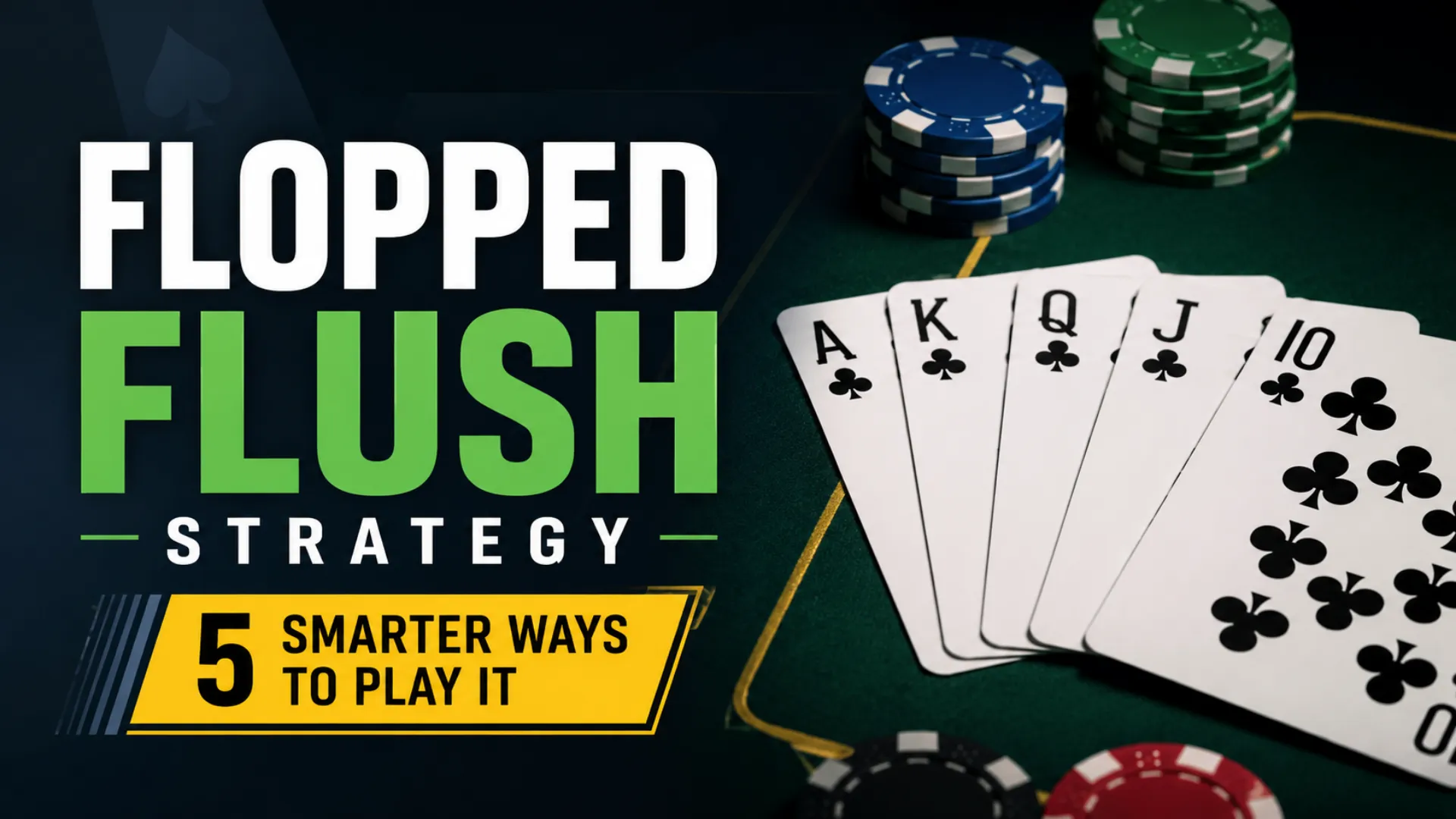
Flopping a flush should make poker easy. You already have five cards of the same suit, so what is left to get wrong?
Quite a lot.
An ace-high flush and a six-high flush belong to the same hand category, but they do not necessarily want to play a big pot in the same way. Position matters. The preflop action matters. Your opponent matters. And one turn card can completely change which flushes are comfortable betting for value.
If you start with two suited hole cards, you will flop a flush only about 0.84% of the time, or roughly 1 in 119 flops. When it finally happens, the goal should not simply be to put as many chips into the middle as possible.
The better questions are: What worse hands can pay you? What better flushes are possible? And what happens to your hand if the board changes?
Here are five dos and don’ts for getting those decisions right.
1. Do Know How Strong Your Flush Really Is
Don’t Play Every Flopped Flush Like the Nuts
Suppose you defend the big blind with 6♠5♠ and the flop comes K♠9♠3♠.
You have a strong made hand, but that does not make it equivalent to holding A♠Q♠ on the same board.
With A♠Q♠, you have the nut flush. No higher flush is currently possible.
With 6♠5♠, several higher suited holdings can already have you beaten.
That distinction becomes increasingly important as the pot gets bigger.
Instead of thinking only, "I have a flush," consider where your hand sits among the flushes both players can realistically hold.
Which suited hands could your opponent reach this flop with? How many higher flushes are possible? More importantly, which worse hands will continue if you bet or raise?
The stronger your flush is relative to both ranges, the more comfortable you can usually be building a large pot. With a low flush facing heavy action, there is more reason to pay attention to exactly what your opponent is representing.
Strong absolute hand strength does not eliminate the need to think about relative hand strength.
2. Do Keep Your Normal Checking Strategy in Mind
Don’t Lead Just Because You Hit a Huge Flop
Imagine you call a preflop raise from the big blind and then flop a flush out of position.
It can be tempting to bet immediately. You finally hit a rare monster, so why give your opponent a chance to check?
Because checking may make you more money.
As the preflop caller, you will generally check a large part of your range to the original raiser on many monotone boards. There is usually no reason to abandon that structure simply because this particular hand became very strong.
Checking allows the preflop raiser to continue betting with much more than flushes. Depending on the board, ranges and bet size, that can include pairs, overpairs, sets, hands containing a high card of the relevant suit, and bluffs.
If you lead immediately, some of those hands may never put money into the pot.
Checking also prevents your betting range from becoming unnecessarily transparent. If your unusually strong hands suddenly lead while most of your other holdings check, observant opponents can start drawing useful conclusions.
This does not mean leading is never correct. Specific range configurations and exploitative situations can justify it.
It simply should not be your automatic reaction to flopping a flush.
3. Do Give Yourself More Than One Way to Continue
Don’t Automatically Slow Play or Automatically Check-Raise
Suppose you check your flush and face a continuation bet.
The next shortcut is easy to make:
"I have a flush, so I should raise."
Sometimes you should.
A check-raise starts building a bigger pot and can extract value when your opponent is willing to continue with enough worse hands.
But raising also forces part of your opponent's betting range to fold.
Against someone who continuation bets too often but becomes cautious when raised, calling can keep weaker hands and bluffs alive for another street.
That is why check-calling a flush is not automatically passive poker.
Sometimes the best way to make money with a strong hand is to leave your opponent enough rope to keep betting.
The reverse is also true. If an opponent calls raises too widely, slow playing everything sacrifices value.
There is no rule saying every flopped flush should be disguised, just as there is no rule saying every flush should start piling money into the pot immediately.
Ask a better question:
If I raise here, which worse hands are actually continuing?
If the answer is "a lot," raising becomes attractive.
If the answer is "very few, but this player keeps bluffing after I call," keeping their weaker range intact may be more profitable.
The action should serve a purpose. The strength of the hand alone does not choose it for you.
4. Do Reassess Your Flush When the Board Changes
Don’t Fall in Love With Your Flop Hand
One reason players misplay flopped flushes is psychological as much as strategic.
You see three cards of your suit on the flop, mentally classify the hand as a monster, and keep that label attached to it even after the board changes.
But hand strength is not fixed.
Two types of runout deserve particular attention.
The first is a fourth card of the same suit.
If you already hold two cards of the suit and the flop contains three more, only eight cards of that suit remain among the 47 unseen cards. That means another suited card arrives on the turn only about 17% of the time.
So fear of the fourth suited card is not a good reason to slow play everything on the flop.
But when that card actually arrives, you do need to reassess.
Return to 6♠5♠ on K♠9♠3♠. If another spade hits the turn, an opponent holding a single higher spade may now be able to make a higher five-card flush.
Your hand is still a flush. Its relative strength has changed.
The second important runout is a paired board.
A flush beats a straight in standard Texas Hold’em, but it loses to a full house. Depending on the exact cards, sets or two-pair holdings from an earlier street can fill up when the board pairs.
That does not mean every paired board is a disaster.
It means you should stop evaluating the hand as "the flush I flopped" and start evaluating the hand you have now against the range your opponent has now.
Every new community card changes the information available.
Good players update with it.
5. Do Make Loose Callers Pay
Don’t Sacrifice Value Just to Look Balanced
Not every opponent needs to be played the same way.
Some players hate folding one-pair hands. Some chase too many draws. Some reach the river with bluff-catchers and then convince themselves to call one more bet.
Against those opponents, hiding a strong flush simply for the sake of deception can cost money.
If a player consistently calls more hands than they should, lean toward extracting value while worse hands are still willing to pay.
This is especially useful at micro and low stakes, where you will often encounter opponents whose calling decisions are much less disciplined than a theoretically balanced strategy assumes.
But exploitative value betting is not the same thing as deciding on the flop that you must bet three streets.
The board can change.
A fourth suited card may reduce the value of your smaller flush. A paired board can strengthen parts of your opponent's range. And a player who called casually on the flop may reveal much more information when they suddenly raise a large turn or river bet.
Keep adjusting.
Against a player who calls too much, value bet more aggressively.
Against someone who bluffs too much, give them opportunities to keep bluffing.
And when a normally passive opponent suddenly wants to play an enormous pot, do not let the word "flush" make the decision for you.
Why Flopped Flushes Are Trickier Than They Look
A flush ranks above a straight and below a full house in standard Texas Hold’em. That makes it a powerful hand, but the ranking chart cannot tell you how much money the hand is worth in a specific pot.
A small flush facing a large river raise is not the same decision as the nut flush facing that raise.
A flush against an aggressive bluffer is different from the same hand against someone who almost never bets without value.
And a flush on a clean runout is different from one played on a board that pairs or eventually shows four cards of the same suit.
The flop may give you the hand.
The remaining streets determine how much that hand is really worth.
The Bottom Line
When you flop a flush, start by identifying what kind of flush you actually have rather than treating every one as a monster that must play for stacks.
Keep position and ranges in mind. Use calls and raises for specific reasons. Reassess when the turn or river changes the board. Most importantly, adjust to the opponent in front of you.
Flopping the flush is the lucky part.
Knowing when to build the pot, when to keep weaker hands alive, and when your once-comfortable flush is no longer as strong as it looks is where the strategy begins.