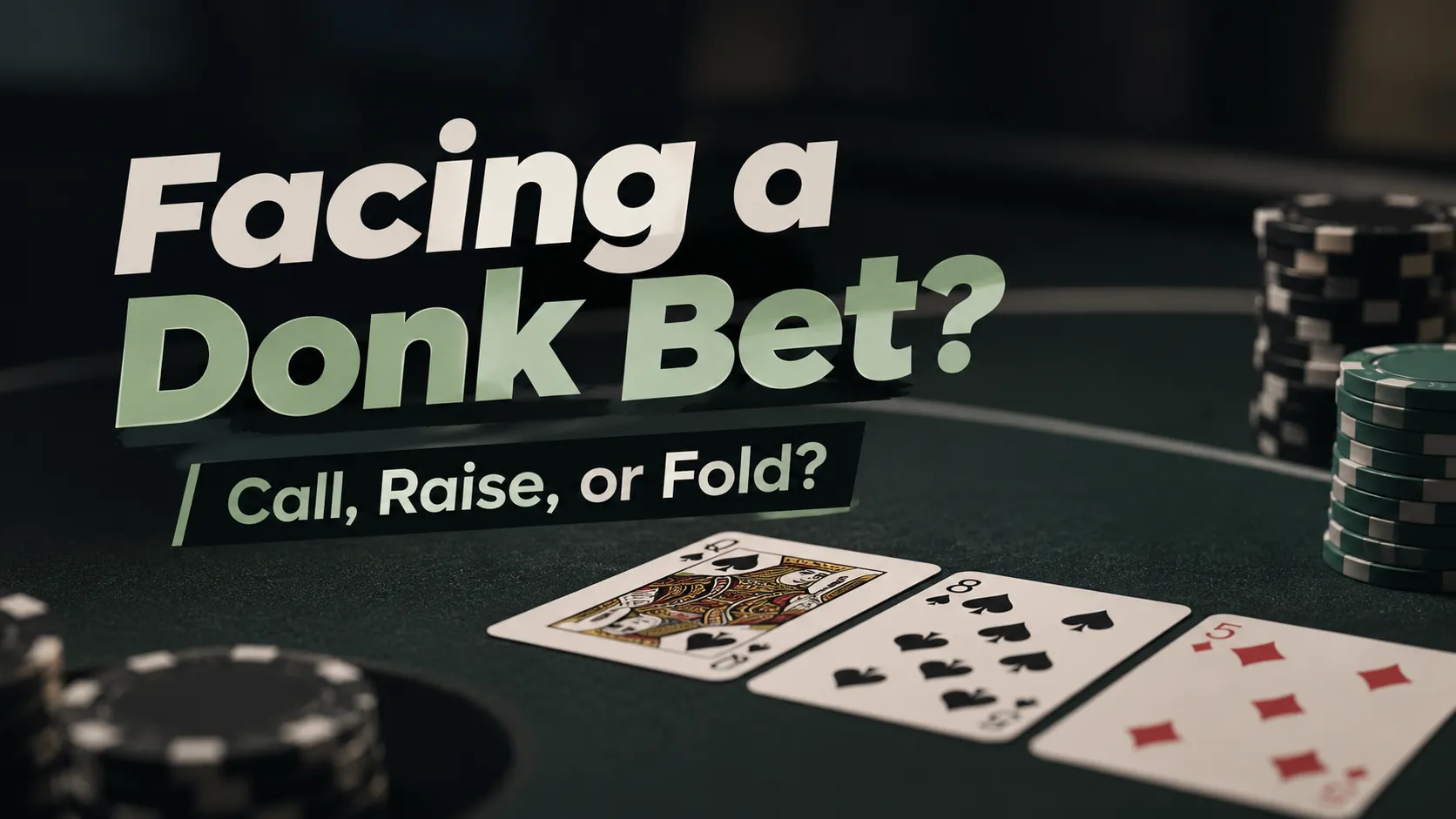
You open from the button, the big blind calls, and the flop comes 7♠6♦4♣. Instead of checking, your opponent leads for half the pot.
Even with AA, this isn't a spot where you can raise without much thought. The big blind can have straights, two pair, and several hands with straight-drawing potential. A raise could leave you playing a larger pot against hands that already beat your overpair.
This type of lead is called a donk bet. It occurs when a player who wasn't the aggressor on the previous betting round bets into that aggressor before they have an opportunity to continue betting.
A donk bet doesn't necessarily indicate a weak hand. Some players lead with vulnerable pairs or draws, while others use a betting range that includes strong hands and bluffs. Your response depends on how those hands interact with the board and what your opponent is likely to do when facing a call or raise.
Read the Board Before You Raise
On 7♠6♦4♣, the big blind's defending range can connect particularly well with the flop.
Against a button open, the big blind may call with suited hands such as 85, 76, and 64, depending on the preflop raise size and effective stacks. Those combinations make straights or two pair on this board.
The button can also hold strong hands, including sets and overpairs. However, when the big blind has several combinations that beat an overpair, raising a donk bet becomes less straightforward.
Now compare that with A♠K♦2♣.
The button's opening range generally contains more AA, KK, and AK combinations than the big blind's calling range. That gives the preflop raiser a substantial range advantage on this board.
If the big blind frequently leads on flops that favor the raiser, it's worth considering whether they're betting too many weak hands.
An opponent who makes small leads with missed hands and frequently folds to raises may offer opportunities to apply pressure. Against someone who rarely leads without a strong hand, the same aggressive approach could be costly.
A favorable board doesn't automatically make the opponent's donk betting range weak.
How Much Should You Defend Against a Small Donk Bet?
Suppose the pot is $30 and the big blind bets $10.
Calling costs $10, bringing the final pot to $50. You need 20% equity to break even, assuming no rake, no further betting, and full equity realization.
Against an opponent who leads with a sufficiently wide range, that price can justify continuing with more than made hands. Some overcards, backdoor draws, and weaker pairs may have enough equity to call.
The challenge comes on later streets.
Imagine calling the flop with two overcards and facing another substantial bet on the turn. If your hand hasn't improved, continuing may become difficult. You might have enough raw equity to justify the initial call but struggle to realize it against repeated aggression.
A pot-sized donk bet changes the calculation.
Under the same simplified assumptions, calling a pot-sized bet requires approximately 33.3% equity. You're committing more chips immediately, and another large bet on the turn can make the decision considerably more expensive.
Bet size also needs to be considered alongside player tendencies.
Some opponents use large bets with both strong hands and bluffs. Others reserve those sizes almost exclusively for value. Defending the same range against both types of players would ignore an important difference in how they construct their bets.
Why Top Pair Often Makes a Better Call Than Raise
Suppose you hold top pair and face a small donk bet.
If you raise, your opponent may fold weaker pairs and bluffs while continuing with two pair, sets, and strong draws. You could end up building a larger pot against a much stronger portion of their range.
Calling keeps those weaker hands involved.
When you're in position, you also get to see what your opponent does on the turn before making another decision.
If they check, you can decide whether to bet for value or check back. If they bet again, the turn card and bet size give you more information about the range you're facing.
Flush draws can present a similar decision.
Against an opponent who rarely folds to raises, calling with a flush draw may be preferable when the pot odds are reasonable.
If your opponent is leading with strong made hands and intends to continue against aggression, raising before completing your draw may simply create a larger pot without generating much fold equity.
When Raising a Donk Bet Makes Sense
A raise becomes more attractive when your opponent is willing to continue with weaker hands.
For example, some players donk bet weak top pairs, second pairs, and flush draws, then call raises with those holdings.
Against that type of player, a set or two pair may benefit from raising immediately. You're giving weaker hands an opportunity to put more money into the pot.
Another useful situation involves opponents who frequently make small leads but fold too often when raised.
A strong draw can become a semi-bluff candidate against that tendency. If the opponent folds, you win the pot immediately. If they call, your hand still has opportunities to improve.
The important consideration is how much of the opponent's betting range will actually fold.
Against someone who rarely folds and mainly leads with strong made hands, a semi-bluff raise loses much of its appeal. You may face a larger pot without gaining enough fold equity to justify the extra chips.
You also need a plan for a reraise.
Before putting more money into the pot, consider which weaker hands will call your raise and which hands you expect to fold.
One Flop, Three Different Decisions
Consider a single-raised pot with 100 big blinds effective.
You open from the button, and the big blind calls.
The flop comes Q♠8♠5♦.
The big blind leads for one-third of the pot.
Q♥J♥: Top Pair
With Q♥J♥, you have top pair and a jack kicker.
If the big blind leads with weaker queens, other pairs, and bluffs, calling is an attractive option. Your hand has showdown value, and keeping those weaker holdings in the pot can be more useful than forcing them out.
Raising becomes more interesting against an opponent who will call with worse queens, weaker pairs, or flush draws.
If those hands usually fold to a raise, however, you may be left facing mostly stronger holdings.
Suppose you call the flop.
If the turn is a blank and your opponent bets small again, you may have a reasonable continuing decision.
If a third spade arrives and your opponent makes a large bet, their value range may now contain completed flushes. You'll need to reassess how your top pair performs against their betting range.
A♠J♠: Nut Flush Draw
With A♠J♠, you have the nut flush draw.
Facing a one-third-pot lead, calling is a reasonable option. You can see the next card relatively cheaply and have the potential to complete the highest possible flush.
Raising is also worth considering against an opponent who frequently leads with weak hands and folds a substantial part of that range when facing aggression.
You may win the pot immediately, while retaining drawing equity when called.
Against an opponent who primarily leads with strong made hands and rarely folds to raises, calling can be the better approach. Your draw remains valuable, but the immediate benefit of a semi-bluff raise is reduced.
A♥J♦: Ace-High
A♥J♦ is a considerably weaker holding on this flop.
You have ace-high, no pair, and no immediate flush draw.
Against an opponent whose donk betting range is concentrated around made hands and strong draws, folding can be reasonable.
If the big blind frequently leads small with weak hands and bluffs, calling becomes more attractive. Your ace-high may still beat part of that betting range.
The difficulty is what happens next.
If your opponent continues betting on most turns, you may struggle to defend an unimproved ace-high hand. A cheap flop call isn't necessarily profitable when future aggression prevents you from realizing enough equity.
The three hands offer different reasons to continue. Q♥J♥ has showdown value, A♠J♠ has substantial drawing equity, and A♥J♦ depends more heavily on how often the opponent is bluffing and how the turn is likely to play out.
Multiway Pots Require a Different Approach
Suppose you raise from the cutoff, and both the button and big blind call.
The big blind leads on the flop. You're next to act, but the button still has a decision to make.
If you call, the button may receive an attractive price to continue with a draw or weaker made hand.
Raising could force the button to fold, denying equity to hands that might otherwise see the turn cheaply. But it also commits more chips when either opponent could be holding a strong hand.
A marginal top pair that performs reasonably well heads-up may be much less comfortable in this situation.
You need to consider both the big blind's betting range and the hands the button might call or reraise with.
Building a large pot with a medium-strength hand becomes less appealing when two opponents can continue against you.
Know What Your Raise Accomplishes
Donk bets can disrupt the action a preflop raiser expects, but that alone isn't a reason to raise.
On boards that connect well with the big blind's defending range, even an overpair may need to proceed carefully. Against someone who leads too frequently with weak hands and folds to aggression, raising can be more attractive.
The decision comes down to the hands that continue and the hands that fold.
If weaker hands are likely to call, raising for value makes sense. If enough hands with meaningful equity will fold, a bluff or semi-bluff may be worthwhile.
If your opponent folds most weaker hands and continues primarily with stronger ones, there's little reason to build a bigger pot simply because you were the preflop raiser.