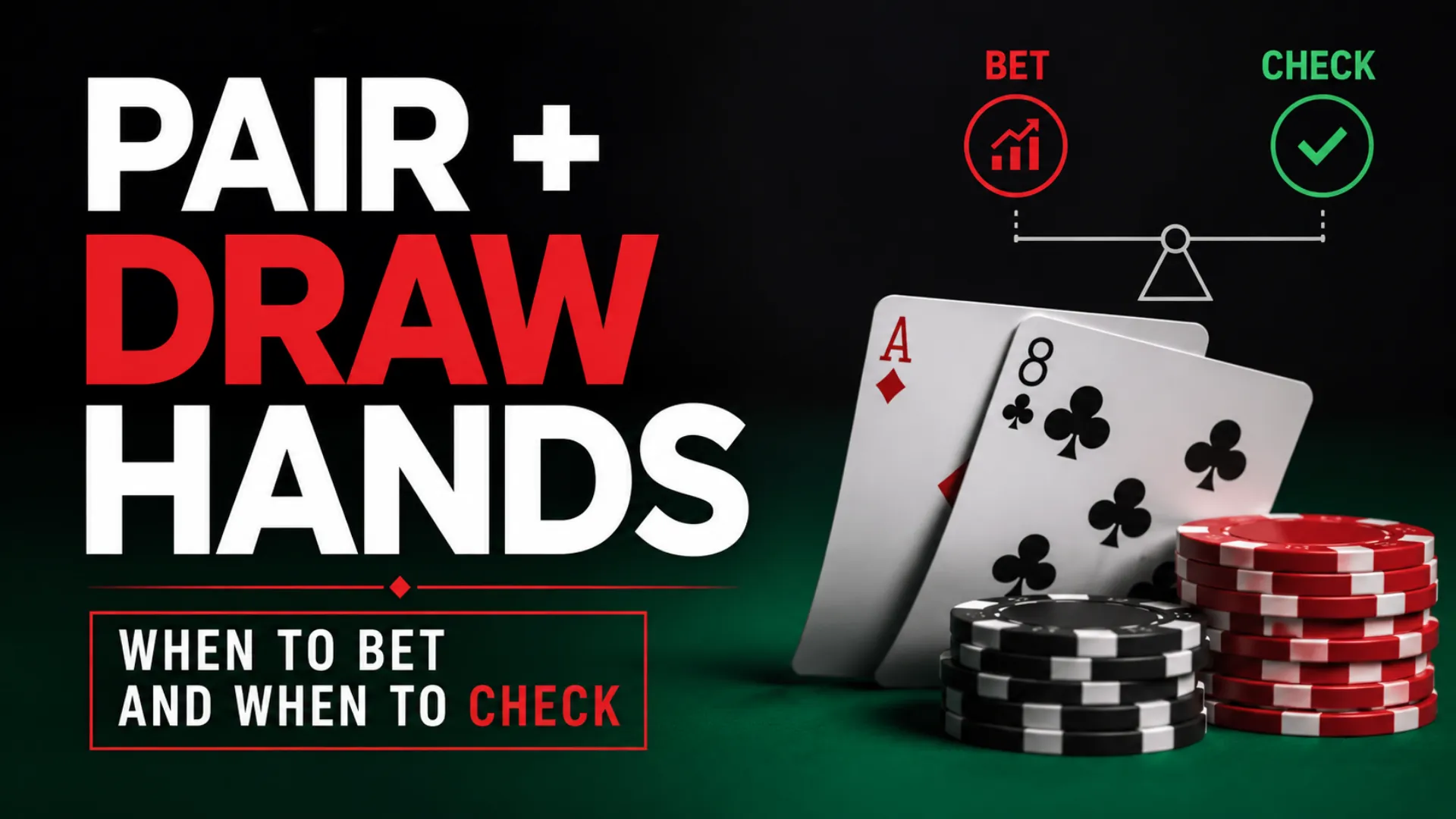
A pair and a draw looks like the kind of hand you should keep betting. You have something made, plenty of ways to improve, and enough equity to feel uncomfortable checking.
That instinct is exactly why these hands get overplayed.
A pair plus a flush draw can be a strong value bet, a semi-bluff, a comfortable check, or a hand you simply want to take toward showdown. The label itself does not tell you which option is best.
Instead of asking, "How strong is my pair plus draw?", ask a more useful question:
What does betting accomplish that checking does not?
That one question helps separate profitable aggression from betting simply because your hand looks too good to slow down.
Not All Pair + Draw Hands Are Equal
Consider how different these hands can be:
- A pair plus the nut flush draw
- Bottom pair plus a weak flush draw
- Middle pair plus an open-ended straight draw
- Top pair plus a gutshot
- A pair plus a draw where some apparent outs may not be clean
They all fit the same broad description, but strategically they can behave very differently.
A♣5♣ on 9♣5♦2♣, for example, is not equivalent to 7♥6♥ on J♥7♣3♥. Both hands have a pair and a flush draw, but the first holds the nut flush draw, while the second can make a flush that is sometimes dominated.
Position, ranges, stack depth, number of opponents and board texture create even more differences.
So "I have a pair and a draw" is never enough reason to bet by itself.
Start With the Pair, Not Just the Draw
The draw is usually the first thing players notice.
Your existing made hand matters just as much.
Suppose you hold 8♠7♠ on Q♠8♦3♠.
Yes, you have a flush draw. But you also have a pair of eights. If the hand reaches showdown without improving, you can still beat unpaired overcards, weaker draws and some other marginal hands.
Now remove the pair and imagine holding 7♠6♠ on the same board.
You still have a flush draw, but unimproved seven-high has very little chance of winning a normal showdown.
That changes the value of aggression.
The second hand has less showdown value to protect by checking, which can make betting more attractive when the opponent, board and ranges give the bluff a realistic chance of working.
The first hand already has another path to winning: simply having the best hand at showdown.
That does not mean it should always check. It means betting has to clear a different hurdle.
Ask Which Better Hands Actually Fold
Before betting a pair plus draw aggressively, identify the stronger hands you expect to make fold.
Not "they might fold something."
Which hands?
Suppose an opponent called the flop with top pair and is unlikely to release it on a harmless turn. Betting second pair plus a draw does not suddenly become an effective bluff simply because you have several outs.
At the same time, forcing worse hands to fold is not automatically worthless.
A hand you currently beat can still have equity against you. Overcards can pair. Draws can complete. A weaker pair can improve to trips or two pair.
Making those hands fold denies some of that equity.
The question is whether the benefit is worth the bet.
A useful rule is:
When worse hands fold and better hands continue, you need a good additional reason to put more money into the pot.
That reason might be meaningful equity denial, a favorable range interaction, useful blockers, profitable future barrels, or an opponent who simply folds too much.
Without one of those factors, checking starts to look much better.
Equity Is Not Automatically a Reason to Bet
One of the biggest conceptual mistakes with pair + draw hands is confusing equity with betting incentive.
A hand can have plenty of equity and still prefer checking.
Suppose you hold 9♥8♥ on K♥9♣4♥. You bet the flop and get called. The turn is the 2♣.
You still have second pair and a flush draw. Plenty of rivers improve you.
But what happens if you bet again?
If weaker hands mostly fold while kings and stronger made hands continue, you may be putting more money into the pot primarily against the section of the range that performs well against you.
Checking preserves your current showdown value while keeping every one of your river possibilities alive.
That is not passive poker.
Poker rewards profitable aggression, not aggression for its own sake.
A Blank Turn Does Not Mean Nothing Changed
Players often see a harmless-looking turn and think the hand is basically the same as it was on the flop.
It is not.
Two things have changed:
- A new card has appeared.
- Another round of action has already filtered both ranges.
If you raised preflop, bet the flop and got called, your opponent no longer has their entire flop range. Some of the weakest hands are gone. What remains is more concentrated around pairs, draws and stronger continues.
That can make a marginal pair less valuable even when the turn card itself appears harmless.
Other turn cards can do the opposite. They may favor your range, create new pressure on one-pair hands, or give your actual hand additional equity.
So "blank turn = check" is not a useful rule.
Ask instead:
Whose range benefits from this turn, and which hands are actually under pressure now?
When Checking Makes Sense
Checking a pair plus draw becomes especially attractive when several factors line up.
You Already Beat Much of the Folding Range
Suppose the hands most likely to fold are ace-high, smaller pairs and missed draws, while most top-pair hands continue.
You do not desperately need those weaker hands out of the pot.
Keeping them in can even help. They may bluff later, check behind and give you another card, or occasionally pay a river value bet when your hand improves.
Getting Raised Creates a Bad Problem
Pair + draw hands often have enough equity to continue against ordinary action without being strong enough to enjoy facing a large raise.
Betting can create that uncomfortable decision yourself.
If checking realizes your equity efficiently while betting exposes you to a raise that makes the hand much harder to play, that cost belongs in the calculation.
You Can Win Without Improving
This is one of the biggest differences between pair + draw hands and pure draws.
Missing your draw does not automatically mean losing the pot.
Second pair can beat ace-high. Bottom pair can beat missed draws. Top pair plus a draw may already be well ahead of a significant part of the opponent's range.
The more useful your current showdown value is, the less urgently you need to manufacture folds.
Your Checking Range Needs Hands That Can Continue
Checking should not automatically announce weakness.
If every decent made hand and every high-equity draw always bets, your checking range becomes easier to attack.
Pair + draw hands can work well in a checking range because they often have enough current strength to continue and enough future equity to become very strong on later cards.
When Betting Is Better
None of this means you should become passive every time you flop a pair and a draw.
Some spots clearly favor betting.
Worse Hands Can Call
This is the cleanest reason.
If weaker pairs, worse draws or other inferior hands can realistically continue, your pair already has a value component.
Now your draw gives you additional ways to improve when you happen to be behind.
Better Hands Can Fold
This creates a genuine bluffing benefit.
The important part is that the folds come from hands that matter.
A turn that puts pressure on marginal one-pair holdings can create a very different betting opportunity from a card that changes almost nothing about your opponent's continuing range.
You Pick Up More Barreling Equity
Some turns improve your hand without completing it.
A pair may add an open-ended straight draw. A straight draw may pick up a flush draw. A new card may also interact strongly with the range you represent.
These are much better reasons to continue betting than simply saying, "I still have a draw."
Your Opponent Overfolds
Poker is played against people, not only ranges on a chart.
If an opponent consistently gives up too often to turn aggression, you should exploit it.
Against someone who calls too much, the adjustment goes the other way. Thin bluffs become less attractive, while value betting stronger hands becomes more important.
Bet Size Matters Too
"Bet or check?" is sometimes the wrong binary question.
A pair + draw may prefer a small bet for value and protection rather than a large polarized bet.
A small sizing can sometimes keep weaker pairs and worse draws in while charging hands that still have live equity. A much larger bet needs a stronger reason, because it generally asks the opponent to continue with a stronger part of their range.
So once you decide betting has merit, ask one more question:
Which hands am I targeting with this size?
If you cannot answer that, choosing the amount as a percentage of the pot is not really a strategy.
Position Changes the Value of Checking
Checking in position and checking out of position are not the same decision.
When your opponent checks to you and you check behind, you guarantee another card without facing a bet on the current street.
That can be extremely valuable with a marginal pair plus draw.
Out of position, checking buys no such guarantee. Your opponent can still bet.
Now you need to know what happens next.
Can you comfortably check-call?
Which sizes can you continue against?
Does your hand block some natural bluffs?
Does this opponent stab too aggressively after a check?
A hand that is an easy check-back in position may require a much more complicated plan out of position.
Multiway Pots Change the Calculation
Pair + draw hands also need more caution when several players see the flop.
With more opponents, there are more ranges that can contain strong made hands and stronger draws. Your fold equity will often be lower, and a non-nut draw becomes more dangerous when several players can continue.
At the same time, protection can become more valuable because more players may have live overcards or weaker draws that still hold meaningful equity against you.
This is why a pair plus a draw that plays comfortably heads-up can require a completely different plan in a multiway pot.
Do not copy a heads-up rule into a four-way flop and expect the same result.
Stack Depth Changes How Much Risk You Should Take
Stack depth matters too.
With a lower stack-to-pot ratio, a strong pair + draw may have enough combined made-hand strength and drawing equity to play very aggressively.
Deep stacked, the same hand can become more complicated.
Dominated draws cost more. Facing a large raise matters more. Making a non-nut flush is less comforting when enormous bets can still go into the pot.
The deeper the stacks, the more important nut potential and future-street playability become.
Not Every Out Is Clean
Counting outs is useful, but apparent outs do not always translate directly into winning cards.
A low flush draw may complete and still lose to a higher flush.
A straight card can complete a larger straight for another hand.
A card that makes you two pair may also complete an opponent's draw.
This is especially important when your draw is not to the nuts.
Do not ask only:
How many cards improve me?
Also ask:
How often does that improvement actually leave me with the best hand?
That distinction keeps you from giving marginal draws more value than they deserve.
A Practical Pair + Draw Decision Test
Before betting, work through these questions.
1. What worse hands call?
If the answer is almost none, your value case is weak.
2. What better hands fold?
Name them. Do not assume "pressure" will magically make a better hand disappear.
3. What happens if I check?
Can you still win unimproved? Can you call a bet? Do you receive a free river in position?
4. How clean are your outs?
A nut draw is not equivalent to a draw that can complete second best.
5. What happens if you get raised?
A difficult response to a raise is part of the cost of betting.
6. Which range likes the board and turn card more?
Your two cards are only one part of the decision.
7. Is the pot heads-up or multiway?
More players can completely change your fold equity and the value of a non-nut draw.
8. How deep are the stacks?
A hand that wants to play a large pot at low SPR may prefer much more control when deep.
9. If you bet, what size actually targets the hands you want?
Do not choose a sizing without knowing what you want it to accomplish.
10. What do you know about this opponent?
An overfolder, a calling station and an aggressive regular should not receive the same strategy.
If your only reason for betting is "I have a lot of equity," you have probably not finished the decision.
The Real Mistake With Pair + Draw Hands
The biggest mistake is not betting them too often.
It is not checking them too often either.
It is treating the hand category as the strategy.
A pair plus a draw feels strong because it combines something you already have with something you can still make. That combination can tempt you into building a pot before working out whether a larger pot actually benefits you.
Sometimes betting extracts value while denying useful equity.
Sometimes it makes better hands fold.
Sometimes checking preserves showdown value and gives you an efficient path to the next card.
And sometimes the same-looking hand needs a completely different line because the position, opponent, stack depth or ranges have changed.
The next time you flop a pair and a draw, do not ask whether the hand is "strong enough to bet."
Ask what the bet is supposed to accomplish.
If you cannot give a convincing answer, checking may be doing far more for your hand than it first appears.