Bad beats are easy to remember. The tournament mistakes that cost you the most are usually much less dramatic.
You look at a 40,000-chip stack and still feel comfortable without noticing that it is now worth only 18 big blinds. You play the bubble the same way you played the opening levels. You register another tournament even though your schedule is already full, or keep playing the same stakes after your bankroll has taken a serious hit.
None of these mistakes guarantees that you will bust.
That is exactly why they are so easy to miss.
Tournament poker constantly changes around you. The blinds rise, stacks become shallower, antes add more chips to the pot, payout pressure grows, and decisions that made sense an hour ago may no longer be profitable.
Learning to adjust to those changes is one of the biggest steps from simply playing tournaments to playing them well.
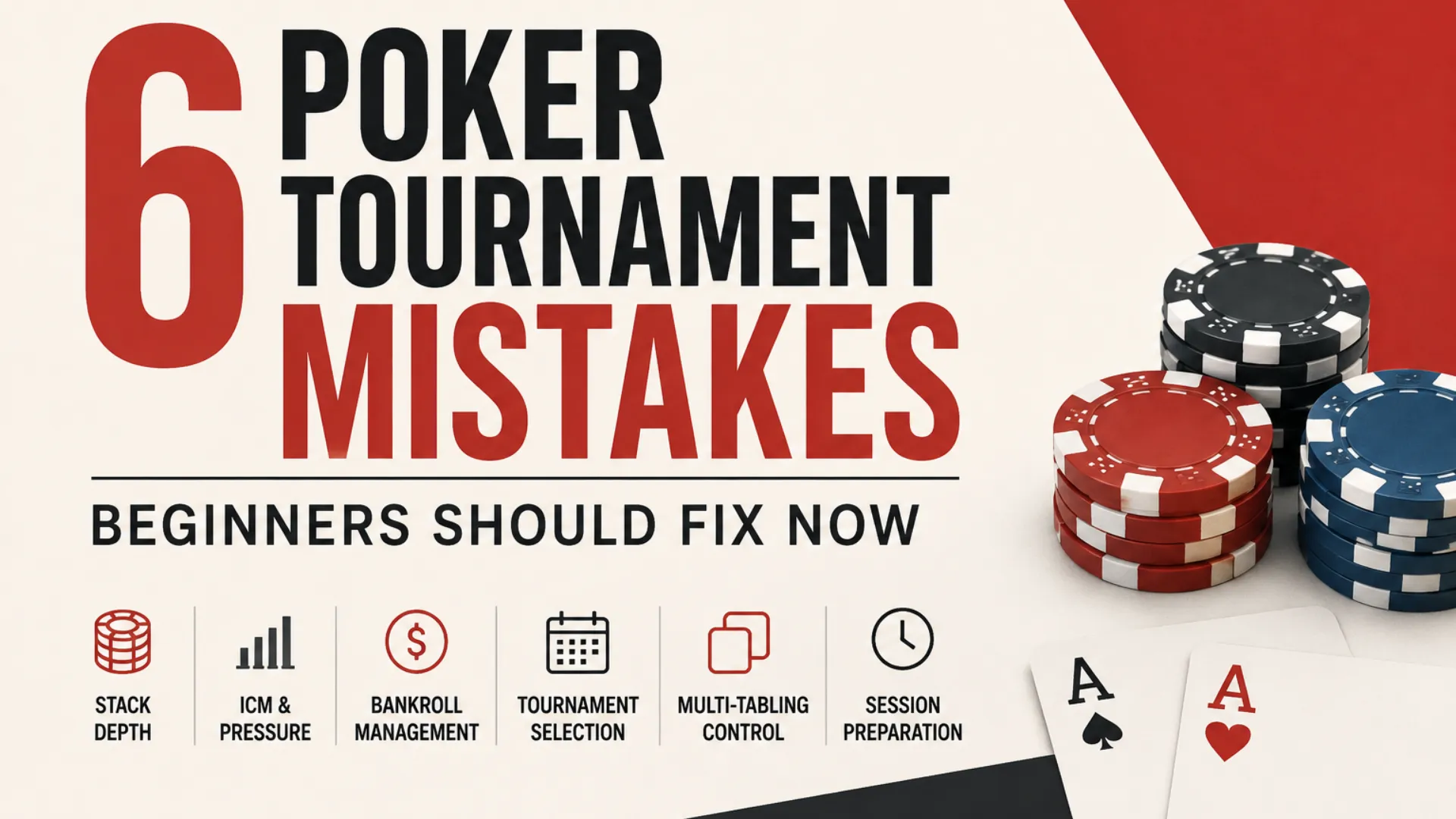
Here are six common tournament mistakes beginners make and what to do instead.
1. Thinking in Chips Instead of Big Blinds
A stack of 30,000 chips can be enormous or dangerously short.
At blinds of 200/400, you have 75 big blinds.
At 1,000/2,000, you have 15.
Your chip count did not change.
Your strategic options did.
That is one of the fundamental differences between tournament poker and a cash game where stacks often remain around a similar depth.
As the blinds rise, the same hands cannot always be played in the same way.
Calling a raise with a speculative hand can make sense when both players are deep and there is plenty of room for postflop decisions. The same call can become much less attractive when the effective stack is only 15 big blinds.
Beginners also tend to focus on their own stack while ignoring the stacks around them.
Suppose you have 45 big blinds, but the big blind you are considering attacking has only 11.
For that confrontation, the effective stack is 11 big blinds.
Your opponent cannot lose 45 big blinds in the hand, so your decision should reflect the stack that can actually go into the pot.
Antes add another layer.
Once antes are in play, there is more money in the pot before anyone voluntarily enters the hand. That extra dead money can make stealing and defending more valuable, so stack depth should never be considered completely in isolation from the blind and ante structure.
What to Do Instead
Get used to converting stacks into big blinds automatically.
Do it for your own stack and for the opponents most likely to enter the pot.
Instead of thinking:
I have 52,000 chips.
Think:
I have 26 big blinds. The button has 18. The big blind has 11.
That information is far more useful when deciding whether to raise, call, three-bet or move all-in.
You do not need to memorize every push-fold chart before entering another tournament. The important first step is understanding that 60BB poker and 15BB poker are not the same game.
2. Playing Every Tournament Stage the Same Way
Tournament strategy does not change only because the blinds get larger.
The value of chips changes too.
Early in a standard tournament, ICM pressure is often relatively small. As the field becomes shorter and meaningful payout jumps approach, however, the consequences of losing chips can become increasingly different from the benefits of winning the same amount.
This is where the Independent Chip Model, or ICM, becomes important.
You do not need to calculate ICM formulas at the table to understand the basic idea.
Tournament chips do not convert into prize money at a constant rate.
Imagine you are a medium stack near the money bubble while several players have only a few big blinds remaining.
Taking a marginal all-in against the chip leader may carry a much greater cost than the same confrontation did several hours earlier. Busting now can mean giving up a realistic chance to cash while much shorter stacks are close to elimination.
But there is another common mistake here.
Some beginners hear "ICM matters" and respond by becoming extremely tight whenever the bubble approaches.
That is not the answer either.
Big stacks can often use payout pressure against players who do not want to risk elimination. Short stacks eventually need to find spots to accumulate chips rather than simply disappear through the blinds. Medium stacks may find themselves under significant pressure because larger stacks can threaten their tournament life.
The correct adjustment depends on the payouts, stack distribution and who covers whom.
What to Do Instead
Start by recognizing the situations where payout pressure becomes especially important:
- approaching the money
- major pay jumps
- final tables
- satellites
- situations where several very short stacks remain
Then add one question to your normal decision process:
What happens to my tournament equity if I lose this pot?
Sometimes that turns a close call into a fold.
In other situations, being the player who can eliminate an opponent gives you more room to apply pressure.
You are not expected to become an ICM expert overnight. The important mistake to avoid is acting as though payout pressure does not exist.
3. Registering Without Checking the Tournament Structure
The Register button is already part of the tournament decision.
Two events with the same buy-in can play completely differently.
One might offer deep starting stacks and long blind levels. Another might have a faster structure, extended late registration and several re-entry opportunities.
If you only look at the buy-in and prize pool, you may end up playing a tournament that does not suit the session you intended to have.
Time is part of the decision too.
A tournament that starts at 9 p.m. could still be running deep into the night if you make a serious run. That is fine when you planned for it. It becomes a problem when you have an early morning and were quietly expecting to be finished in three hours.
The same issue appears with multi-tabling.
Four tables may feel comfortable during the opening levels. Later, one reaches the bubble, another becomes short-handed and two others produce difficult decisions at the same time.
The number of tables did not change.
The amount of attention they demand did.
What to Do Instead
Before registering, check:
- starting stack
- blind level length
- ante structure
- late registration period
- re-entry rules
- payout structure
- likely field size
- expected finishing time
- how the event overlaps with the rest of your schedule
Do not choose the maximum number of tables you can physically keep open.
Choose the number at which you can still follow stack sizes, action, tournament stage and changing table dynamics without constantly rushing.
Playing fewer tables well is better than playing more tables on autopilot.
4. Playing Tournaments Your Bankroll Cannot Support
Tournament results rarely arrive in a smooth line.
You can play well for dozens of tournaments without making a serious run, then recover much of the loss with one final table. Large fields, top-heavy payouts and re-entry formats can make those swings even more pronounced.
That makes bankroll management especially important in MTTs.
One common mistake is looking at a single tournament buy-in and deciding whether it is affordable without considering the rest of the schedule.
Suppose you have a $1,000 poker bankroll.
Playing an occasional $11 tournament is very different from regularly entering $11, $22 and $33 events, especially when several of them allow re-entry. The headline buy-in might look manageable while your total session exposure tells a different story.
Field size matters too.
A 90-player tournament and a 5,000-player tournament can have the same buy-in, but they will not produce the same pattern of results. In much larger fields, final tables and top finishes naturally occur less often, which can create longer stretches between your biggest scores.
There is no universal bankroll rule that fits every tournament player.
The right level depends on your average buy-in, the formats you play, typical field sizes, how often you re-enter, your edge and how much financial risk you are willing to accept.
What to Do Instead
Track your average buy-in, or ABI, rather than looking only at the most expensive tournament you occasionally play.
Also pay attention to:
- the typical size of the fields you enter
- how often you re-enter
- the structures and formats you usually play
- how much you spend across an entire session
- whether you can comfortably replenish your poker bankroll
- whether losing a significant portion of the bankroll would affect your decisions
Most importantly, decide when you will move down in stakes before a downswing happens.
Bankroll management will never remove tournament variance. Its job is to stop normal variance from removing you from the games.
5. Adding More Tables Than Your Decisions Can Handle
Multi-tabling can increase volume.
It can also make bad decisions much harder to notice.
When action starts arriving faster than you can process it, the first things to disappear are often the details.
You stop noticing who has tightened up.
You miss that the big blind has dropped to eight big blinds.
You continuation-bet a board because that is what you usually do rather than because the bet makes sense.
Then a genuinely difficult spot appears and half your time bank is already gone.
This does not always feel like tilt.
Often, it feels completely normal.
You are clicking buttons. The tournaments are moving. Nothing looks obviously wrong.
That is what makes autopilot dangerous.
The same problem appears when poker competes with your phone, social media, videos, chat windows or anything else demanding your attention.
One distraction is unlikely to destroy an entire tournament.
Repeated low-quality decisions can still quietly eat into your results.
What to Do Instead
Find your real table limit instead of copying someone else's.
If your decisions become rushed at six tables, playing four is not a step backward. It may improve the quality of hundreds of decisions over the course of a session.
Use scheduled breaks to check messages instead of keeping notifications active throughout play.
Keep your setup simple enough that important information is easy to see.
And pay attention to one of the clearest signs of autopilot:
If you cannot explain why you just raised, called or folded beyond "that's what I normally do," your attention may already be slipping.
6. Starting a Long Session Without Preparing for a Long Session
Tournament poker creates an unusual performance problem.
The better your tournament goes, the longer you may need to keep playing.
A cash-game player can usually choose to leave after a few hours.
If you have 18 players left in a tournament you have been playing all evening, stopping because you are tired is not a realistic option.
That makes preparation part of tournament strategy.
Starting an eight-hour session already exhausted means your most important decisions may arrive when you are least prepared to make them.
The same applies if you have not thought about food, water, breaks or basic real-life commitments until several tournaments are already running.
The preparation does not have to be complicated.
What matters is starting a session you can realistically finish.
What to Do Instead
Before starting a long tournament session:
- get a reasonable amount of sleep
- have food and water available
- plan around scheduled tournament breaks
- avoid entering events that are likely to clash with important commitments
- stop registering new tournaments when your concentration is clearly declining
The goal is not perfect physical optimization.
It is to remove avoidable problems before they interfere with your decisions.
A final table is not the time to discover that your schedule only worked if you busted three hours earlier.
The Biggest Tournament Mistake Is Failing to Adjust
Most beginner tournament mistakes share the same underlying problem.
The player keeps following the same plan after the situation has changed.
The blinds increase, but the player still thinks only in chips.
Antes enter the structure, but preflop decisions remain unchanged.
The tournament reaches the bubble, but every all-in is evaluated as though it were a cash game.
The schedule becomes harder to manage, but another table gets added anyway.
The bankroll gets smaller, but the buy-ins stay the same.
Good tournament poker is built around adjustment.
Perfect ranges and flawless ICM calculations can come later. What matters first is noticing what has changed, understanding why it matters and making a better decision because of it.
Bad beats will always be part of tournament poker.
The mistakes you can control are a much better place to focus.