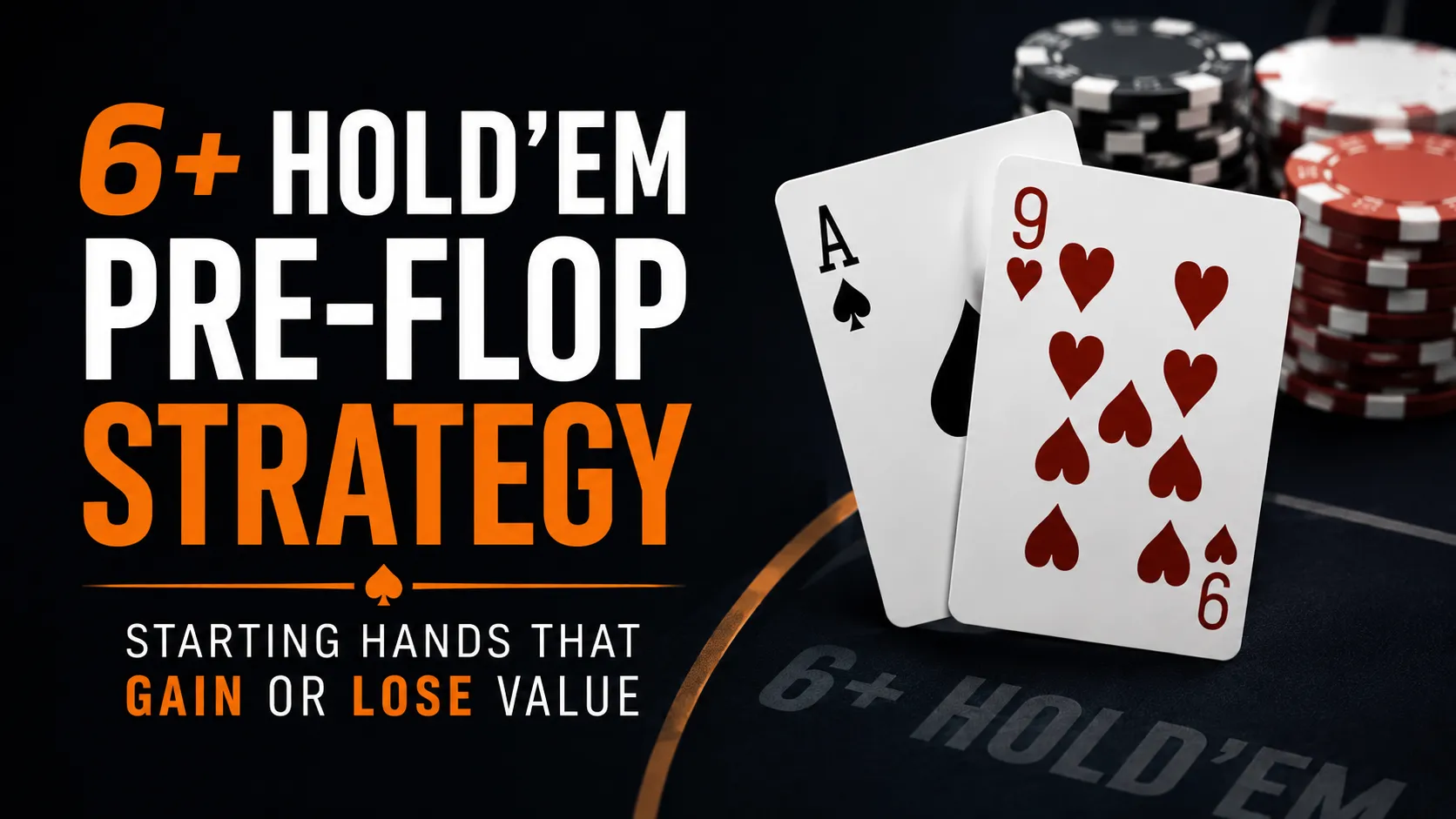
In 6+ Hold’em, you flop a set more often than in Texas Hold’em, yet small pocket pairs can become harder to play. Flushes are harder to make, yet suited starting hands become more valuable.
Those two facts explain why normal Hold’em instincts can be misleading in Short Deck.
The cards still look familiar, but their relative value has changed.
With every card from two through five removed, 6+ Hold’em uses a 36-card deck containing only nine ranks: 6, 7, 8, 9, T, J, Q, K and A. That compressed deck raises the average quality of starting hands and creates a much denser network of straight possibilities.
The goal is not to memorize a new list of "good" and "bad" hands. It is to understand what makes a starting hand useful when everyone is drawing from the same concentrated deck.
Start With the 36-Card Deck
One of the easiest mistakes in 6+ Hold’em is judging starting hands by normal Hold’em standards.
In a 52-card game, opponents can hold a huge number of weak combinations such as 52o, 73o or J4o. Those hands simply do not exist in Short Deck.
As a result, average starting-hand quality rises.
An ace still has obvious high-card value, but simply holding an ace is less distinctive when every player is drawing from a much tighter range of ranks. The same principle applies to kings, queens and other high cards.
This shifts the focus away from individual card strength and toward how well your two hole cards work together.
A hand that can develop into strong straights, flushes and two-pair combinations often has more useful paths forward than a disconnected offsuit hand that mainly hopes to make top pair.
Range Compression Makes Connected Hands More Valuable
The remaining ranks in 6+ Hold’em are packed closely together:
6 7 8 9 T J Q K A
There are no twos, threes, fours or fives creating large gaps at the bottom of the deck.
That makes straight structures much denser.
Take T9. In standard Hold’em, many ranks in the deck have little direct connection to its straight potential. In Short Deck, a much larger share of the available ranks sits close enough to interact with T9 on future boards.
Connected and closely connected hands therefore have more ways to develop.
A hand such as JTs can make pairs, two pair, trips, straight draws, made straights, flush draws and made flushes.
Compare that with something like K8o.
K8o has obvious high-card strength, but its two cards cooperate far less effectively. Much of its post-flop value depends on making a pair, which can become an awkward destination against stronger starting ranges and boards with dense straight possibilities.
This does not mean every connector is automatically playable.
It means connectivity deserves more weight when you compare otherwise close pre-flop decisions.
There is also one Short Deck straight new players should know immediately. An ace can play low in A-6-7-8-9, producing a nine-high straight.
That creates additional straight interaction around aces and the lower end of the Short Deck that does not exist in standard Hold’em.
Suited Hands Gain Value Even Though Flushes Are Harder to Make
This is one of the most counterintuitive adjustments in 6+ Hold’em.
Suited cards become strategically more attractive, but not because flushes are easier to complete.
They are not.
Each suit contains only nine cards in a 36-card deck rather than 13 in a standard deck.
If you hold two suited cards and the flop contains two more cards of that suit, only five unseen cards of the suit remain. In standard Hold’em, nine would remain.
The important change is what a flush is worth once you make it.
Under PokerStars-style 6+ Hold’em rankings, a flush beats a full house.
That makes suitedness a particularly valuable source of nut potential.
Consider JTs and JTo.
Both can make the same straights. Both can make pairs and two pair. But only JTs can develop into a flush using both hole cards.
That extra path to a very high-ranking hand carries significant value in a format where the deck produces a high concentration of playable holdings.
The lesson is not simply "play suited cards."
A better principle is:
When two starting hands have similar ranks and connectivity, suitedness can create a much larger strategic difference in Short Deck than many Hold’em players expect.
Pocket Pairs Make Sets More Often, but That Does Not Make Set Mining Automatic
Pocket pairs produce one of the biggest statistical adjustments in Short Deck.
In standard Hold’em, a pocket pair flops a set or better roughly 11.8% of the time.
In a 36-card 6+ deck, that figure rises to about 17%.
The reason is simple. Once you hold a pocket pair, two cards of that rank remain available, but there are fewer unseen cards in the deck.
At first glance, that sounds like excellent news for 66, 77 and 88.
It is, but only partly.
The more important distinction is between how often you improve and how valuable that improvement is.
Under rules where a straight still beats three of a kind, a flopped set is powerful but does not carry exactly the same relationship to the rest of the deck that it does in standard Hold’em. Straight possibilities are much denser, and strong draws are a regular feature of Short Deck boards.
So while small and medium pairs improve more frequently, that does not mean they should automatically be treated as better set-mining hands.
Position, effective stack depth, action before you and the strength of opposing ranges still matter.
Premium pocket pairs are different. Aces and kings still begin with substantial raw pre-flop strength.
The mistake is not playing pocket pairs.
It is assuming that a higher set frequency alone tells you how profitable they are.
Weak Offsuit Aces Lose Some of Their Automatic Appeal
In normal Hold’em, hands such as A8o and A9o can be perfectly reasonable late-position opens.
Part of their value comes from how weak the possible holdings behind them can be.
Short Deck reduces that advantage.
There is no 42o, 53o or 83o sitting near the bottom of an opponent's possible holdings. The average hand behind you is stronger, so a weak offsuit ace no longer enjoys the same relative edge.
There is also a post-flop problem.
When A9o makes an ace, it often creates one pair with a mediocre kicker. That can become uncomfortable against stronger aces and a deck structure that creates plenty of straight draws, two-pair combinations and other strong holdings.
The same logic applies to hands such as K8o and Q8o.
These hands are not automatically folds. Position, stack depth, ante structure and opponent tendencies can all change the answer.
But a high card alone should not earn a hand an automatic place in your pre-flop range.
A more useful question is:
If this hand receives action, what strong five-card combinations can it realistically become?
Look Beyond One-Pair Strength
This question provides a useful shortcut for evaluating Short Deck starting hands.
Instead of asking:
"Is this a decent high-card hand?"
ask:
"How many strong ways can this hand develop?"
Hands that combine high card strength, connectivity, suitedness and nut potential have several possible routes forward.
They can develop toward strong straights, flushes, two pair and other powerful combinations rather than depending mainly on top pair.
A disconnected offsuit hand may look respectable before the flop but become awkward when its most common attractive outcome is one pair with limited redraw potential.
This does not make top pair worthless.
It means one-pair strength should not be the only reason a borderline starting hand looks attractive.
Always Check the Rules Before Building a Range
Not every Short Deck game has historically used exactly the same rules.
PokerStars-style 6+ Hold’em ranks:
- a flush above a full house
- a straight above three of a kind
Other Short Deck formats have used different rankings, particularly around straights and trips.
That difference matters strategically.
If three of a kind outranks a straight, the relative value of pocket pairs changes. If a straight outranks trips, connectivity becomes more important by comparison.
Forced-bet structures can vary as well.
PokerStars 6+ Hold’em uses an ante from every player with an additional blind posted by the button. Other Short Deck games may use different structures.
Before applying any pre-flop advice, confirm:
- hand rankings
- ante structure
- button blind or blind structure
- effective stack depth
- number of players
Strategy follows the rules of the game you are actually playing.
A Practical Pre-Flop Filter for 6+ Hold’em
You do not need to memorize every possible starting-hand matchup to improve your Short Deck decisions.
Instead, evaluate a hand with four questions.
1. Do the Cards Work Together?
Connected and closely connected cards generally have more ways to improve than disconnected holdings.
2. Are They Suited?
Flushes are difficult to make, but their high ranking gives suited hands valuable upside.
3. Can the Hand Make the Nuts?
Nut potential matters when your hand develops into a strong combination and the pot grows.
4. Is the Hand Too Dependent on One Pair?
If most of its attractive outcomes are simply top pair with a mediocre kicker, its pre-flop appearance may be stronger than its post-flop prospects.
A useful mental framework is:
card quality + connectivity + suitedness + nut potential
rather than:
high card = good hand
The Real Adjustment Is Redefining a Good Starting Hand
6+ Hold’em is not standard Hold’em with the weakest cards removed.
The 36-card deck changes what makes a starting hand valuable in the first place.
Connected cards benefit from dense straight possibilities. Suited hands gain access to a particularly valuable hand class. Pocket pairs make sets more often, but higher set frequency alone does not make every small pair a better investment. Weak offsuit high cards lose part of the advantage they enjoy against the much wider collection of poor starting hands found in standard Hold’em.
The practical adjustment is simple:
Value starting hands for the strong five-card combinations they can build, not just for the pair they might make on the flop.
Once that idea becomes natural, 6+ Hold’em pre-flop strategy starts making sense on its own terms.