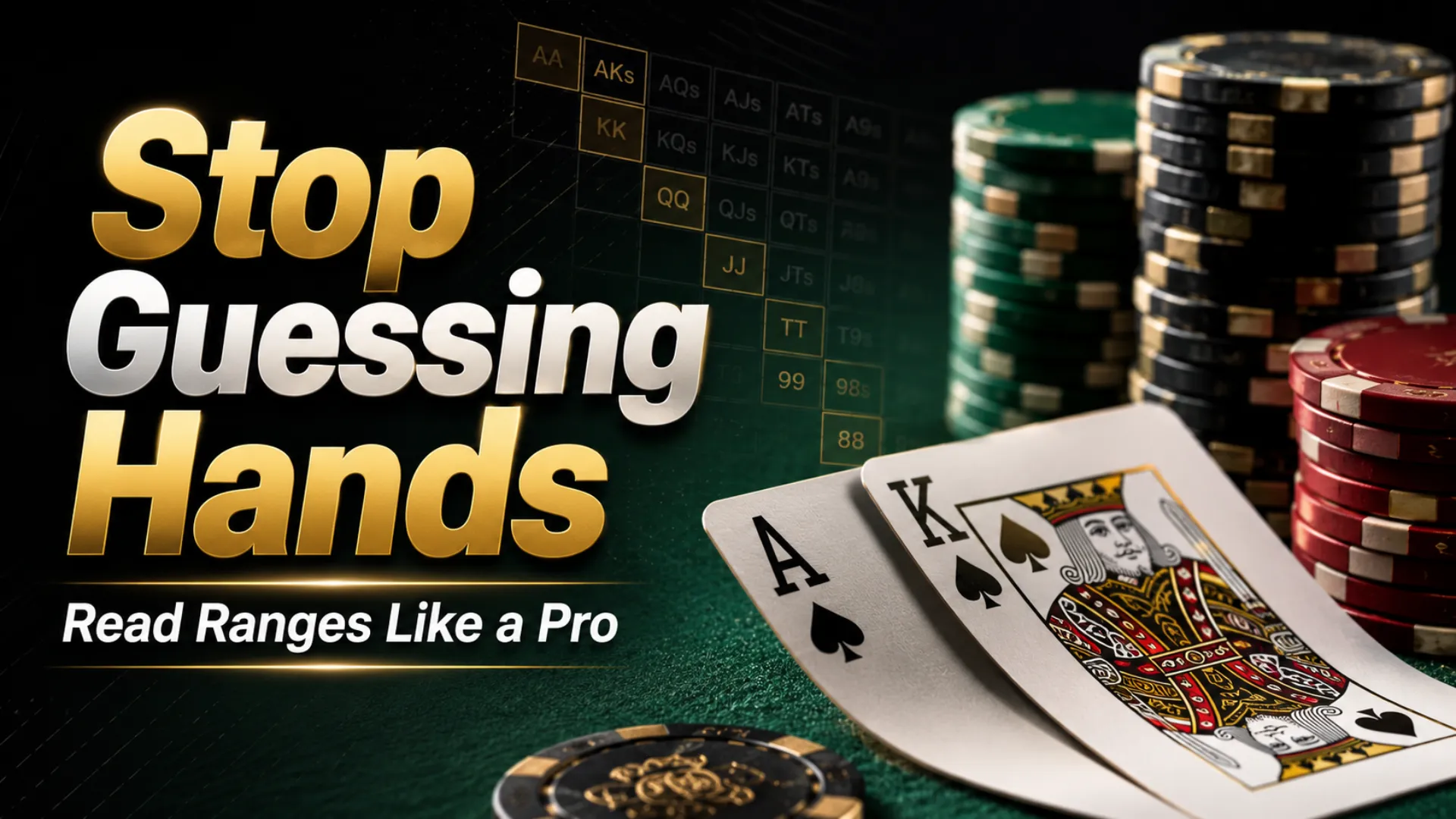
Hand reading in poker is not about guessing one exact holding. The real skill is building a realistic range, removing hands that no longer fit the action, and choosing the highest value decision against the hands that remain.
To put an opponent on a range, start with the hands they can realistically enter the pot with based on position, player type, stack depth, and preflop action. Then narrow that range on every street using board texture, bet sizing, blockers, and line consistency. The goal is not perfect prediction. The goal is better decisions: thinner value bets, cleaner folds, and bluffs that target the right part of their range.
Who This Guide Is For
This guide is written for Texas Holdem players who already understand basic hand rankings but still struggle with questions like “What can my opponent have here?” or “Is this river bet value or a bluff?” It is especially useful for small and mid stakes cash games, online poker, live poker, and tournament spots where players often make readable mistakes.
The focus is practical. You will learn how to think in ranges without needing solver output at the table, how to avoid emotional hero calls, and how to turn vague reads into structured decisions.
What Hand Reading Really Means
Many beginners hear “hand reading” and imagine a dramatic hero call where someone says, “You have ace king,” then flips over the winning hand. That is entertaining, but it is not how strong poker decisions are usually made.
In real poker, hand reading means building a range of possible holdings and updating that range as new information appears. A range can include value hands, medium strength hands, draws, missed draws, traps, and hands that only appear because a specific opponent plays too loose or calls too often.
The key mindset: you are not trying to name your opponent’s exact two cards. You are asking, “Which hands make sense for this player, from this position, on this board, with this bet size, and through this line?”
The Range Funnel: A Practical Model
A useful way to think about hand reading is a range audit. At the start of the hand, your opponent can have many possible holdings. Every action should either remove hands, increase the weight of certain hands, or reveal that the opponent is capable of taking unusual lines. If the range does not change after new action appears, you are probably watching the hand instead of reading it.
A tight regular, a loose recreational player, a passive caller, and an aggressive three bettor do not start with the same range. Before you analyze the board, classify the opponent in a simple way: tight or loose, passive or aggressive, value heavy or bluff capable.
An under the gun raise is usually stronger than a button raise. A small blind cold call is usually different from a big blind defend. Position gives you the first filter.
Open raise, limp call, three bet, cold call, squeeze, and overcall all represent different hand groups. Do not treat every “call” as the same kind of call.
Ask which hands connect strongly, which hands pick up draws, which hands miss, and which player has more credible strong hands on this texture.
Strong players often tell a coherent story across streets. Weak players often reveal themselves when their line does not match credible value hands or natural bluffs.
The Six Inputs That Matter Most
Good hand reading does not come from one clue. It comes from combining multiple clues and weighting them correctly. The table below gives you a clean checklist to use during real hands, especially when you face a large bet and need to decide whether the story is credible.
| Input | What It Tells You | Common Reading Mistake | Better Question to Ask |
|---|---|---|---|
| Position | How wide or tight the starting range should be. | Assuming a button raise and early position raise are similar. | How wide can this player reasonably be from this seat? |
| Preflop action | Whether the range is strong, capped, speculative, or defensive. | Ignoring the difference between calling, three betting, and cold calling. | Which hands would choose this exact preflop action? |
| Board texture | Which player connects better with the flop, turn, or river. | Only looking at your own hand strength. | Who has more nutted hands and strong draws here? |
| Bet size | Whether the range looks thin, polarized, protective, or exploitative. | Assuming large always means strong and small always means weak. | What hands gain from using this size? |
| Blockers | Which value hands or bluffs become less likely because of cards you hold. | Using blockers as an excuse to call every bluff catcher. | Does my hand remove value, remove bluffs, or both? |
| Player tendency | How often the opponent deviates from balanced strategy. | Applying solver logic to someone who rarely bluffs or overcalls too much. | What does this specific player overdo? |
Range Types You Need to Recognize
Once you start thinking in ranges, the next step is learning what shape that range has. This is where many players improve quickly because they stop asking only “strong or weak?” and start asking “what kind of strong, what kind of weak, and how many of each?”
Strong hands are limited
A capped range has fewer very strong hands than the opponent’s range. For example, a player who only calls preflop often has fewer premium pairs than the original raiser.
Top hands are still possible
An uncapped range can still contain the best hands. A preflop raiser or three bettor often keeps overpairs, sets, and premium hands in range.
Very strong or bluff heavy
A polarized range contains strong value hands and bluffs, with fewer medium hands. Big river bets are often polarized because medium strength hands usually prefer checking or smaller sizes.
Mostly medium strength
A condensed range contains many one pair hands, second pair hands, and bluff catchers, but fewer nutted hands and fewer pure air hands.
Equity but not made strength
On boards with flush draws, straight draws, and overcards, an opponent may continue with many hands that are not made yet but still have future equity.
Many hands bet for value and protection
A merged range includes strong hands and medium hands that benefit from value, protection, or denying equity. Smaller flop bets often create merged continuation betting ranges.
Street by Street Hand Reading Framework
Preflop: Build the Starting Range
Preflop is where the range is formed. If your preflop assumption is poor, your postflop read will become unreliable. Start with position, stack depth, table dynamics, and player profile.
| Preflop Situation | Typical Range Shape | What to Watch |
|---|---|---|
| Early position open | Tighter, more high card and pocket pair heavy. | Do not assign too many weak suited hands unless the player is loose. |
| Button open | Wider, more suited connectors, suited aces, broadways, and steals. | Many hands can miss hard on low or paired boards. |
| Big blind defend | Wide and price dependent, often many suited and connected hands. | This range can connect with boards that the raiser misses. |
| Three bet | Usually stronger or more polarized, depending on player type. | Against tight players, give more credit. Against aggressive players, keep bluffs in. |
| Limp call | Often capped, passive, and weighted toward playable but non premium hands. | Do not ignore traps from tricky players, but assume passive ranges until shown otherwise. |
Flop: Compare Range Advantage and Nut Advantage
The flop does not affect both players equally. A dry king high flop often favors the preflop raiser. A low connected flop may favor the big blind defender. Before you decide whether your opponent is strong, ask which player should have more strong hands and more natural continues on this texture.
Range advantage means one player has more overall strong and medium hands. Nut advantage means one player has more of the very best hands. These are not always the same thing.
Turn: Separate Real Equity From Float Equity
The turn is where many weak reads fall apart. Some flop calls become stronger, some draws lose value, and some overcard floats now have to decide whether to bluff or give up. When the turn changes the board, update the range instead of carrying your flop assumption forward automatically.
River: Count Value and Missed Draws
River decisions should be based on the value hands that remain and the natural bluffs that missed. If a player makes a large river bet, ask which strong hands they credibly represent, which missed draws they can have, and whether this player type actually turns those missed hands into bluffs.
Example 1: Big Blind Defends and Check Raises Flop
Example 2: Tight Player Triple Barrels
How Bet Sizing Changes the Range
Bet size is one of the most useful hand reading clues, but it must be interpreted in context. The same large bet can represent different ranges depending on board texture, player type, stack depth, and whether previous actions capped either player.
| Bet Size Pattern | Often Represents | Exploitative Adjustment |
|---|---|---|
| Small flop bet on dry board | Wide range, often many overcards, pairs, and automatic continuation bets. | Do not overfold. Continue with hands that retain equity and can improve. |
| Large flop bet on wet board | Strong made hands, protection hands, strong draws, and combo draws. | Defend with hands that can stand pressure across later streets. |
| Small turn probe after flop checks through | Thin value, protection, delayed stab, or range attack against weakness. | Raise selectively when you block strong hands and unblock folds. |
| Overbet turn or river | Often polarized: nutted value or bluffs that want maximum fold equity. | Call with blockers to value and fold bluff catchers that block missed draws. |
| Tiny river block bet | Medium strength hand trying to set the price, sometimes a trap. | Raise when their range is capped and your story is credible. |
Using Blockers Without Fooling Yourself
Blockers are powerful, but many players misuse them. Holding a card that blocks your opponent’s value range can make bluffing or bluff catching more attractive. Holding cards that block your opponent’s bluffs can make calling worse.
You reduce value and allow bluffs
If you hold the ace of a completed flush suit, your opponent has fewer nut flushes. If you do not block their missed straight draws, their bluff count remains more realistic.
You block the hands you want them to have
If your bluff catcher blocks missed draws but does not block value, it may look attractive while performing poorly. A blocker is useful only when it changes the range in the right direction.
How to Count Value Hands and Bluffs on the River
A river call becomes much clearer when you stop thinking in feelings and start counting categories. You do not need perfect combo math at the table, but you should be able to list the main value hands and the main missed draws.
| River Question | Why It Matters | Practical Example |
|---|---|---|
| What hands value bet this size? | This prevents you from calling simply because your hand looks strong in isolation. | If only sets and two pair bet large, one pair becomes a bluff catcher. |
| Which draws missed naturally? | Real bluffs usually come from hands that had equity earlier and missed by the river. | Missed flush draws and open ended straight draws are more natural bluffs than random air. |
| Do I block value or block bluffs? | Your cards can make their strong hands or missed draws less likely. | Holding the ace of the flush suit can reduce nut flush combos, but holding missed draw cards can reduce their bluff combos. |
| Does this player bluff enough? | Population tendencies matter. Some players have the right bluff candidates but do not pull the trigger. | Against passive live players, large river bets are often more value heavy than theory assumes. |
Common Hand Reading Mistakes
Do not begin with “what if they have the nuts?” Begin with all reasonable hands, then narrow the range based on action, board texture, and player tendency.
A player who raises from early position should not be assigned the same weak hands as a button opener unless you have evidence.
Balanced logic matters, but a passive live player who rarely bluffs should not be treated the same as an aggressive online regular.
Timing can help, but it is less reliable than position, range, board texture, and sizing. Use timing as a supporting clue, not the foundation of the read.
If an opponent calls flop, raises turn, and jams river, their range should look very different from the range they had preflop.
A Simple Practice Routine
You do not need to solve every hand perfectly to improve. The fastest path is to review hands in the same structured order every time.
After a session, pick three difficult hands and write the opponent’s possible preflop range based only on position and action.
For flop, turn, and river, cross out hands that no longer make sense. Add notes for hands that become more likely.
On the river, list likely value hands and likely bluffs. If you cannot find enough bluffs, you probably should not make a big hero call.
Do not only ask whether you were right. Ask which part of the process failed: starting range, board reading, player tendency, or bet size interpretation.
Quick Range Reading Checklist
What position did they start from? What hands take this preflop action? Who has range advantage on this board? Does their bet size make sense for value, protection, or bluffs? Which natural draws missed? Which value hands do I block? Which bluff candidates do I block? Does this specific player bluff enough? If the answers are unclear, avoid emotional calls and choose the lower variance line.
FAQ
What does it mean to put someone on a range in poker?
It means assigning your opponent a realistic group of possible hands based on their position, action, bet sizing, board texture, and tendencies. You then narrow that group as the hand progresses.
Is hand reading only for advanced players?
No. Beginners can start by using simple filters: position, preflop action, flop connection, and player type. Advanced players add blockers, range shape, combo counting, and exploitative adjustments.
Should I try to guess my opponent’s exact hand?
Usually no. Guessing one exact hand leads to emotional decisions. Thinking in ranges helps you compare all likely value hands, bluffs, and medium strength hands.
How do I know if an opponent is bluffing?
Look for missed draws, credible value hands, bet size, line consistency, and player tendency. A bluff is more believable when the opponent has natural missed hands and a history of aggression.
What is the biggest mistake in hand reading?
The biggest mistake is starting with a conclusion. Strong players start with a range, narrow it street by street, and let the evidence guide the decision.
Want Better Poker Decisions?
PokerOffer helps players discover reliable poker rooms, tournament opportunities, and practical poker strategy content. If you want to improve your game selection, compare poker platforms, or discuss poker options, contact us anytime.
This article is for poker education and general strategy discussion. Poker involves risk, variance, and local legal restrictions. Always play responsibly and follow the rules in your jurisdiction.