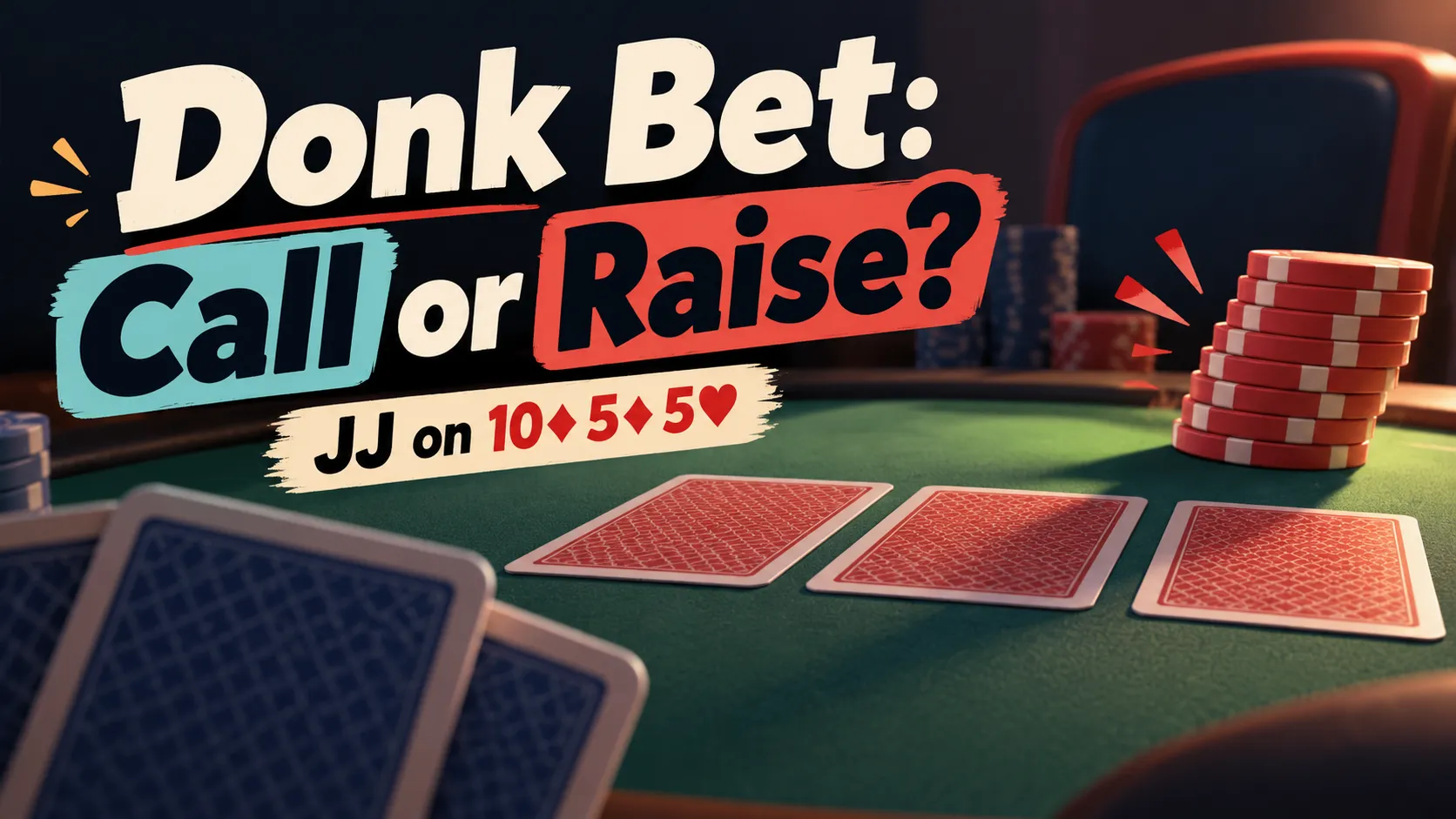
You open from the hijack with JJ, and the big blind calls. The flop comes T♦5♦5♥. Instead of checking, the big blind bets into you.
With an overpair, you might be tempted to raise. But if the big blind is leading mainly with trips and bluffs, raising could force out the bluffs while leaving you against their strongest hands.
The big blind can have more combinations of 5x than a typical hijack opening range, even though the hijack has more premium pocket pairs. That difference makes the big blind's betting range especially important when deciding whether to call, raise or fold.
What Is the Big Blind Leading With?
In a single-raised pot, the big blind usually checks to the preflop raiser. When the big blind bets first, the action is known as a donk bet.
Some players lead with trips to build the pot. Others bet vulnerable pairs, hoping to get value from weaker hands while denying their opponent a free turn card.
On T♦5♦5♥, the hijack generally has more premium pocket pairs, while the big blind's defending range can contain more 5x combinations.
That gives the two players different advantages. The hijack may have the stronger overall range, but the big blind can have more trips.
If the big blind leads primarily with trips and bluffs, raising JJ may fold out many of the hands you're beating. Their 5x hands, meanwhile, can comfortably continue.
Against someone who frequently leads with Tx or weaker pocket pairs, the calculation changes. If those hands are willing to call a raise, JJ has a clearer opportunity to win a larger pot against weaker holdings.
You need to know whether the big blind is betting a polarized range of strong hands and bluffs or a wider selection of medium-strength hands.
Why Calling with JJ Can Be Better Than Raising
Calling is worth considering when the big blind's donk-betting range is heavily polarized.
Against a range made up mainly of trips and bluffs, raising JJ may accomplish little. The bluffs can fold, while trips remain willing to play a larger pot.
Calling keeps those weaker hands involved and leaves room for the big blind to bluff again on the turn.
You also have position. After calling the flop, you can see what the big blind does on the turn before deciding how to proceed.
If they check, you can bet or check back. If they continue betting, the turn card and their sizing help you reassess the strength of their range.
Some turn cards will make JJ harder to play.
On T♦5♦5♥, another diamond can complete a flush for an opponent holding two diamonds. An ace, king or queen may also improve hands that were previously behind JJ.
If the big blind continues betting heavily, consider which value hands they could have and whether enough bluffs remain to justify another call.
Deeper effective stacks make these decisions more consequential. A modest flop call can lead to a much larger pot by the river.
The same reasoning doesn't extend to every hand.
With two unpaired overcards and little additional equity, you may struggle to continue against another bet. If your hand has poor showdown value and few useful turn cards, folding the flop can be preferable to calling simply because the price looks attractive.
When Should You Raise a Donk Bet?
Raising becomes more appealing when your opponent leads too frequently with medium-strength hands.
Some players bet weak pairs rather than check and face a continuation bet. If they rarely include trips or other strong hands in that leading range, they may have difficulty defending against raises.
Their response to aggression determines how you can exploit the mistake.
Suppose the big blind frequently donk-bets Tx on T♦5♦5♥ and continues calling raises with those hands. With JJ, you may be able to raise for value because weaker pairs are willing to put more money into the pot.
Against a player who leads frequently but folds too often when raised, selected bluff-raises become more attractive.
One opponent gives you value by calling too widely. The other creates opportunities to win the pot immediately by folding too much.
GTO Wizard examined this type of adjustment in a nodelocking study of players who lead too often with medium-strength hands.
The analysis used cash-game situations with an UTG raiser against the big blind on unpaired flops. Under those conditions, the preflop raiser could respond to excessive medium-strength leads by raising more frequently.
Those findings support the general adjustment, but the specific raising frequencies do not transfer directly to T♦5♦5♥.
On a paired flop, the big blind can credibly represent trips. Raising aggressively without evidence of a weak or unbalanced leading range can become expensive.
Before raising JJ, consider which weaker hands will call and which stronger hands will continue.
If Tx regularly calls, raising has a clearer value target. If most bluffs fold and 5x continues, calling deserves greater consideration.
How Bet Size Changes Your Decision
Suppose the flop pot is $100, and the big blind bets $20.
Calling costs $20, and the pot will contain $140 after your call. Your direct pot odds therefore require approximately 14.3% equity.
That gives you a better price than facing a larger bet, but it doesn't make every hand with 14.3% raw equity a profitable call.
You still have to realize that equity on later streets.
Imagine calling the flop with two unpaired overcards. If the turn misses your hand and the big blind bets again, the next decision may be much more expensive.
A larger donk bet requires more immediate equity to call, putting greater pressure on weak draws and marginal hands.
Bet sizing can also provide information about your opponent's range.
A polarized range containing strong hands and bluffs may favor larger bets. A range containing more vulnerable pairs may use smaller sizes to extract thin value or deny equity.
Those patterns are useful, but actual opponents don't always follow them.
One player might consistently lead small with weak pairs, while another uses the same sizing with strong hands. Previous showdowns and betting patterns can help you determine what a particular size means for that opponent.
Why Stack Depth and ICM Matter
The same flop can produce different strategies depending on effective stacks and tournament conditions.
GTO Wizard examined a nine-handed final-table situation in which the hijack held 20bb and the big blind, who was the chip leader, held 53bb.
The hijack opened, the big blind called, and the flop came T♦5♦5♥.
In the ranges used for this simulation, the big blind had approximately 38% equity. Despite that disadvantage, the solver included donk bets in its ICM strategy and preferred a 50%-pot sizing when betting.
The big blind's additional 5x combinations helped support a polarized betting range containing trips and bluffs.
Tournament risk also influenced the strategy.
The hijack could be eliminated by losing the remaining stack, while the big blind could lose the pot and remain in the tournament. At a final table, that difference affects how both players approach a potentially large pot.
Using the same preflop ranges in a 20bb chip-EV simulation produced a different result. On T♦5♦5♥, the big blind had no equilibrium flop donk-betting strategy.
Introducing the final-table ICM conditions changed the incentives.
The preflop raiser's response also depended on the board.
In a separate GTO Wizard analysis of the same final-table setup, the hijack raised less frequently against donk bets on T♦5♦5♥ than on the other two flops examined.
The big blind's polarized betting range made calling attractive because it preserved bluffs without unnecessarily building a larger pot against trips.
However, the solver raised more frequently against certain larger bets. Under ICM pressure, denying the opponent equity and future bluffing opportunities can sometimes be worth more than keeping weaker hands involved.
These findings apply to the ranges, stack sizes and tournament conditions used in those simulations. They are not fixed instructions for every paired flop.
Deeper effective stacks introduce further considerations. More money behind gives the big blind greater opportunities to apply pressure with trips, while the preflop raiser must consider how a flop raise could affect the size of the pot on later streets.
On T♦5♦5♥, JJ can call to preserve bluffs against a polarized leading range. Raising becomes more attractive when weaker pairs will continue or when the opponent folds too frequently to aggression.
With a hand that has little showdown value, limited equity and poor prospects on later streets, folding remains a reasonable option.
The most useful question before raising is which hands the big blind will still have in their range after facing your raise.