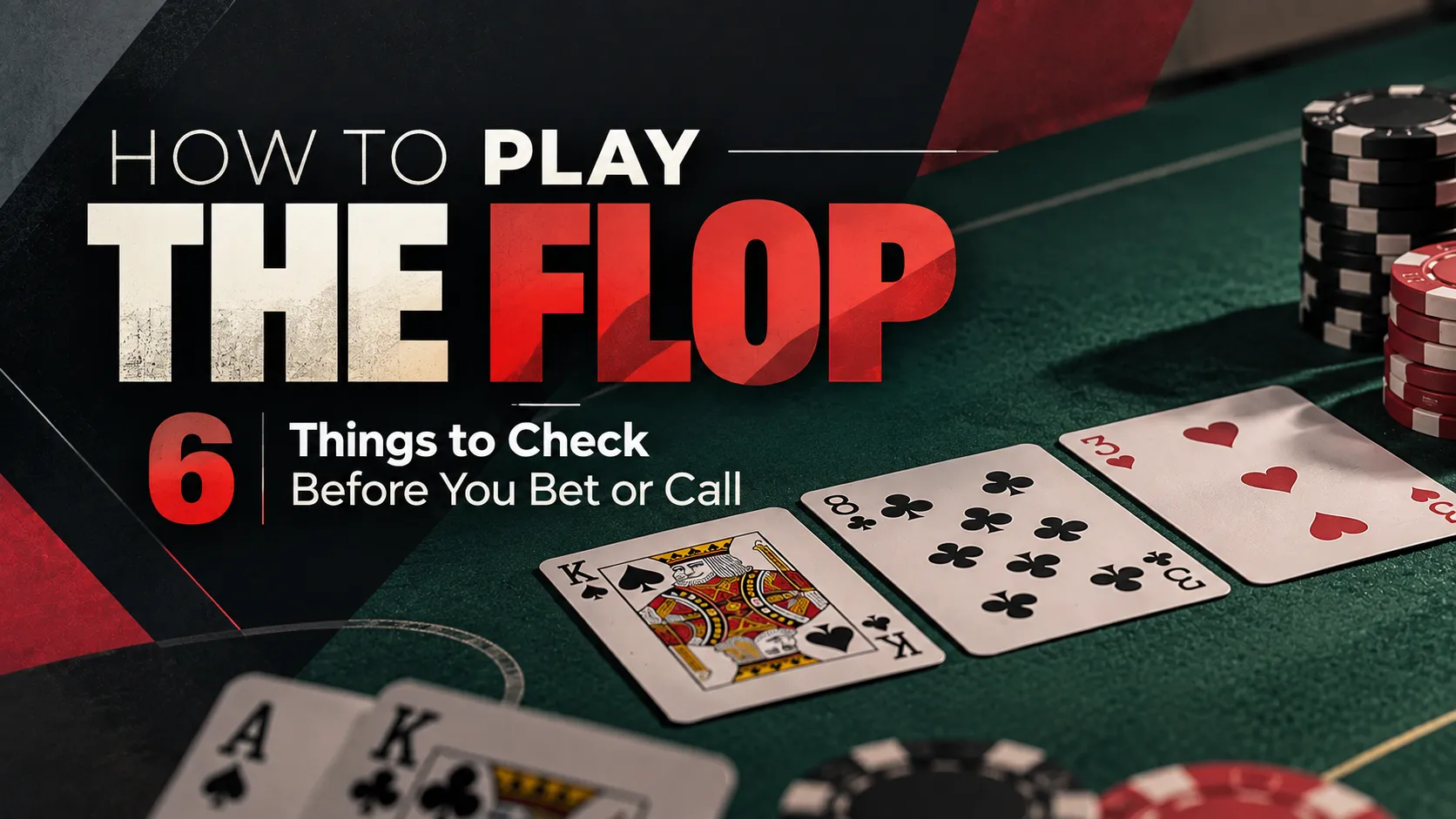
You look down at A♠ K♣. The flop comes K♦ 8♣ 3♥. You hit top pair, top kicker. Dream start on a dry board.
Now deal that exact same A♠ K♣ on a J♦ 10♦ 9♦ flop. Suddenly you are clinging to Ace-high and a gutshot, praying your opponent does not already have a flush.
Same premium starting hand. Completely different reality.
Flop play is not just about what you hit. It is about what the board changes. Knowing you have top pair or a draw is only step one. The real decision comes from combining your hand with the board texture, the preflop action, your position, and the price of continuing.
Stop guessing. Start making profitable decisions by asking yourself these six questions on every flop.
1. How Strong Is Your Hand on This exact Board?
Hand strength is relative.
Take A♣ 8♣ on a K♠ 8♦ 4♥ board. You hit middle pair. You are ahead of unpaired hands, but any king beats you. So do pocket nines or better, plus any two pair or sets. The question is not "Did I pair the board?" It is "How does my pair perform against the hands my opponent can realistically hold?"
Top pair needs the exact same reality check.
With K♣ 7♠ on K♦ Q♦ 10♣, you paired the highest card, but you are swimming in danger. Better kings are everywhere. A-J and J-9 already made straights. Anyone holding two diamonds is on a flush draw.
If you want to bet for value, name the worse hands that will actually call you. If you face a bet, estimate how much of their betting range you actually beat. Bet sizing, player tendencies, and stack depths dictate the answer.
A pair gives you a made hand. It does not automatically give you an excuse to build a massive pot.
2. Which Range Connects Better With the Flop?
Board texture tells you what the community cards make possible.
| Flop | Texture | What to Notice |
|---|---|---|
| A♣ 7♦ 2♠ | Dry, rainbow | No immediate flush draw and little straight connectivity |
| J♥ 10♥ 9♣ | Connected, two-tone | Made straights, flush draws, and pair-plus-draw combos are active |
| K♥ 8♥ 3♥ | Monotone | A player with two hearts already has a flush |
| Q♠ Q♦ 5♣ | Paired | Trips, full houses, and quads are possible |
Texture alone is useless without preflop context. You need to know which player is more likely to hold the hands that connect with that board.
An early-position raiser arrives at the flop with a much tighter range than a button opener. A big blind caller's range shifts entirely based on who raised and for how much.
This brings up two critical concepts:
- Range advantage: Which player's overall range has more equity on this specific board.
- Nut advantage: Which player's range contains more of the absolute strongest hands available.
They are not the same. You can have a stronger overall range without holding the largest share of the nutted hands. Generally, a range advantage allows you to bet more frequently, while a nut advantage lets you bet larger.
Do not overcomplicate it. Connect the flop to the preflop story. An Ace-high board might perfectly suit the preflop raiser, while a low, connected board often smashes the big blind caller.
3. What Price Are You Getting to Continue?
A draw looks appealing until you look at the price tag.
You hold 8♣ 7♣ on K♠ 9♦ 4♥. An eight or seven on the turn gives you a pair, but if your opponent has a king, you are still drawing nearly dead. When counting outs, only count the cards that realistically give you the winning hand, not just a better hand category.
When facing a bet, the math dictates your next move.
How to Calculate Pot Odds
Required equity = Amount to call ÷ Total pot after your call × 100
Let us say the pot is $100 and your opponent bets $50.
| Item | Amount |
|---|---|
| Pot before the bet | $100 |
| Opponent's bet | $50 |
| Your call | $50 |
| Total pot after calling | $200 |
| Required equity | 25% |
You are paying $50 to win a total pot of $200. $50 ÷ $200 = 25%
Ignoring rake and future betting, your hand needs at least 25% equity against your opponent's betting range to break even on a call.
4. Are You Using the Right Draw Odds?
A standard flush draw gives you 9 outs.
With one card to come, 9 outs give you roughly a 19% chance to hit on the turn. If you are guaranteed to see both the turn and river, that jumps to 35%.
Do not mix these numbers up.
If you need 25% equity to call a flop bet, and that call only guarantees you see the turn, your 19% chance is mathematically unprofitable by itself. You cannot use the 35% figure unless the river is free.
Before you click call on a draw, check four things:
- Clean outs: Does hitting your card actually give you the nuts?
- Implied odds: Will you win a massive pot if you hit?
- Future betting: Are you prepared to face another barrel on the turn if you miss?
- Other equity: Do you have overcards or backdoor draws adding hidden value?
5. How Does Position Change Your Options?
Position dictates leverage.
You raise the button with A♣ 8♣. The big blind calls. Flop: K♠ 8♦ 4♥. If the big blind checks, you can comfortably check back, control the pot size, and see a free turn card. You dictate the pace.
Now flip it. You defend the big blind with A♣ 8♣ against a button raise. Same flop. You check, but the button still acts. You cannot guarantee a free turn.
Position does not change the mathematical strength of A-8 on a K-8-4 board. It changes your ability to realize that equity and control the price of poker.
6. What Is Your Plan After the Flop?
Never make a flop decision without thinking one street ahead.
Before betting, define your purpose. Are you value betting to get called by worse? Are you bluffing to fold out better? If your hand is purely medium-strength, checking often preserves its value without inflating the pot unnecessarily.
This directly applies to Continuation Bets (C-bets). Being the preflop aggressor does not mean you are legally obligated to c-bet every flop.
Consider the board interaction. Look one card ahead:
- What is your plan if the turn is a complete blank?
- What changes if the obvious flush draw gets there?
- Are you prepared to fold if you get check-raised right now?
You do not need a master plan for all 47 possible turn cards. You just need a logical reason for putting chips in the middle right now.
A 6-Question Flop Checklist
Before you act, run this mental loop:
- How strong is my hand on this exact board? Factor in kickers, draws, and multi-way action.
- Who does this board favor? Evaluate preflop ranges and positions.
- What price am I getting? Calculate pot odds. Never guess.
- Are my outs clean, and am I pricing them right? Turn odds vs. River odds.
- How does my position dictate my options? Decide if you can take a free card or pot-control.
- What is my plan for the turn? Prepare for blanks, scare cards, and raises.
Stop acting just because you have top pair or raised preflop. Let the board, the math, and the ranges dictate your play.
Frequently Asked Questions About Poker Flop Strategy
What Is the Flop in Poker?
The flop is the first three community cards dealt face-up after the preflop betting round. In Texas Hold'em, you combine these with your two hole cards to build the best five-card hand.
What Should I Evaluate First on the Flop?
Always start with your hand relative to the board texture. Immediately layer in the preflop action, likely ranges, position, and the bet sizing you face. Having a flush draw is meaningless in a vacuum.
Should I Always Continuation Bet After Raising Preflop?
No. While the preflop aggressor often has the range advantage, a c-bet still needs a profitable purpose. Board texture, positional disadvantage, and multi-way pots should frequently lead to checking.
Is Top Pair Always Strong Enough to Raise?
No. Top pair ranges from a premium value hand to a marginal bluff-catcher depending on your kicker and the board texture. Raising often folds out all the hands you beat and only gets action from hands that crush you.
When Should I Call With a Flush Draw?
When your pot odds and implied odds justify the price. Remember that a 9-out flush draw only hits on the next card 19% of the time. Ensure your outs are clean and factor in whether you will face another bet on the turn.
What Is the Difference Between Range Advantage and Nut Advantage?
Range advantage means your entire spectrum of possible hands has higher average equity on a board. Nut advantage means your range contains a higher concentration of the absolute strongest hands possible on that board.